The Five Principles of Disaster Resolution
Translator's note. The longest and most systematic piece in this collection: five principles for cancelling a predicted disaster, and eleven forms that external aid can take. Two things make it worth reading even for a sceptic. First, the underlying claim is physical rather than magical — a disaster is an abnormal quantity of energy, and resolution means either blocking it with equal energy or routing it into another channel. Second, the passage on talismans is a piece of real analysis: it dissolves the talisman into its materials and finds five Chinese drugs. Where the author is wrong he is at least wrong in a way you can check.
What is a disaster? Harm done by nature or by people.
What is resolving one? Using human intelligence and capacity to stop it happening, to avoid it, or to cancel as much as possible of what has already happened.
Whatever the disaster and whatever its size, if we can accurately predict its cause, its time and its place, we can reduce the loss to a minimum, and often cancel it entirely. The Tangshan earthquake was catastrophic because the prediction work had not been done. The Yangtze flood peak of 1998 was met with clear objectives and minimal harm because the prediction was good — when the peak would arrive, and where, was known accurately in advance.
So there is no disaster that cannot be resolved. The key is accurate and timely prediction.
Out of a great deal of practice I arrived at what I call the five principles. Across nearly a thousand cases — illness, litigation, divorce, loss of money — it has held: apply these five and a great disaster becomes a small one, and a small one becomes none.
Principle one: right consciousness
Before anything can be adjusted, the person being adjusted must want it. By right consciousness I mean that a person facing disaster must have a strong intention to resolve it, and must cooperate actively. Given a particular environment, he must first be willing to have it changed and willing to work with you on it. If he is unwilling, or if you explain what to do and he does not do it, then no feng shui adjustment on earth will help.
Matter determines consciousness, and consciousness acts back on matter; correct consciousness promotes, incorrect consciousness obstructs. In practice this is exact. A patient who does not want to live cannot be saved by the best physician — cure him and he will find another road. Right consciousness is the most basic precondition for changing a fate.
Principle two: place and direction
Do not be at the place where the disaster will happen. That is the method.
A man travelling from Guangzhou to Beijing, or from Harbin to Beijing, is moving along a direction and to a place. The direction of travel affects a fate enormously. A human life is not essentially different from a tree, a grass, a sheep. Move a coconut palm from Hainan to Harbin and it lives at best from summer to autumn; move it in winter and it dies faster and worse. Transplant a northeastern pine to Hainan and in a few years it may flourish and seed.
Set aside climate. In moving, a person cuts across the geomagnetic field at an angle. Guangzhou to Beijing is running against the field. Harbin to Beijing is a diagonal cut across a south-running field. Japan to China is a transverse cut across it. Travel one way along the lines of force and the effect on your fate is one thing; travel another and it is another. Direction of travel matters more than the feng shui of a dwelling.
Principle three: time
Miss the moment at which the disaster would occur. That is the method.
Two people arrange to meet. With a place and an intention but no time, they may run into each other by luck, or never meet in a lifetime. Time affects a fate enormously — but time does not decide a fate.
Only when time, direction and environment are unified does time mean anything. Strip away direction and environment and all times are meaningless. Is environment meaningful without time? Yes. Your mother does not tell you what hour she will be home, but wait in the house and she will come. Tell her only that she is going out today, without saying where, and you may never find her. Environment outweighs time by a great deal. Time becomes important only in matching with environment; on its own it is nothing, because time is neither matter nor energy. In ordinary understanding, every thing has a course from birth to death, and time is the instrument for recording that course. It is not a cause.
You may prefer to call time an energy. But that energy is fair to everyone, balanced for everyone. Being equal for all things in the universe, including people, it can be set at zero. Environment is not equal: lie on damp ground long enough and you fall ill; sleep eight hours in a bed and fatigue lifts and the mind clears. So the balanced term drops out of the equation, and what decides a fate is environment.
Principle four: external aid
Bring outside force to bear.
A man's foot is pinned under a boulder he cannot lift. If someone helps, the foot comes free and the disaster is over.
External force is the crux of whether a disaster can be resolved. The forms it takes:
1. Adjusting the environment
Changing the energy-field configuration of where a person lives. In this whole catalogue, this is the principal and most fundamental technique.
2. Medicine and specific foods, to balance the body's internal field
A diabetic who eats less sugar changes his fate. Eating particular things can bring a person wealth, or position, or the knowledge he wants.
A child who will not study may genuinely need his diet changed — and parents generally feed a child what he likes, beef every day if he likes beef. What those parents may not know is that beef, which helps another child, may be seriously damaging this one's intellectual development.
No one is so clever that being drunk leaves him clear-headed. There is a Buddhist story of an arhat of great power who could subdue demons and tame tigers; one day he lay drunk by the roadside and a toad came and licked the food from his mouth. A man of supernatural capacity, unable to deal with a toad, because he was drunk.
So do not underestimate what food does to a fate, and do not eat what should not be eaten.
Physicians speak of a balanced diet. Before the 1980s, for thousands of years, where in China was there any such balance? Not from unwillingness — there simply was not the food. People ate the same few things all their lives: in the north, millet, maize, sorghum, sweet potato, potato, radish, cabbage, and very little wheat. Tens of generations lived that way. So the point is not balance; the point is eating what you need. Change a child's diet and a child who would not read may change materially. This is not superstition; it is testable.
3. Colour, to balance the five-element field
See my book Invisible Negotiation.
4. Qigong practice, to adjust the field
Whether or not qigong or religious practice draws energy from the cosmos, at least this much is true: while you practise, the mind can settle. A settled mind relaxes the body moderately, and a relaxed body presents more surface, more volume — which means more of the benign “zero-state energy” of the universe can be taken in. On that ground the method is viable.
5. Changing the name, to force others to emit a field favourable to you
Does changing a name work? Yes. But a name does not decide a fate; at most it accounts for one or two per cent. What it certainly does is shift a person's own psychology.
6. Doing good, to change the information field of the people around you
So that the field becomes favourable to your own existence.
7. Religion, rites, taking refuge — to connect with a field beyond the ordinary
Believing is like qigong, except that qigong trains body and mind together while religion mostly trains the mind. But a change of mind produces a change of behaviour, and a change of behaviour supplies motive force to a change of fate.
All religions perform rites. Do rites work? Certainly they do. How much they work depends on two things. First: are you doing it with a sincere heart, or are you acting? Second: who is performing it for you.
Rites have two kinds of content.
Rites of reconciliation. You must speak sincerely, yourself, to the people you have wronged, the people who have hated you, the people you have hated. Whether that conversation works depends entirely on whether you are sincere. Pay someone else to do it and the grievance cannot be dissolved — because the other party knows whether you mean it. That such beings are ghosts and spirits means they have capacities we do not: we cannot tell what they are thinking; they may well tell what we are thinking. That is the difference between their realm and ours.
And who performs the rite matters as much. Think of a mediator between two quarrelling parties: without standing, without one party's trust, he reconciles nothing. Two people in dispute who trust no lawyer cannot be helped by a lawyer; who trust no judge cannot be helped by a judge. The one performing the rite is mediator, lawyer and judge at once. Whether the reconciliation succeeds depends on whether he has standing with both sides — either their trust or their fear — and only real cultivation gives him that. Without standing he may make the quarrel worse.
Rites of petition. Praying for descendants, for office and wealth, for health and long life. Here the essential thing is sincerity; this is not a game. Treat it as a game and the bodhisattvas will not trouble themselves — but the guardians will. Only after that does it matter who performs it, and by then the performance has become secondary. You are petitioning the bodhisattva directly; if the bodhisattva needed a third party to learn what you were asking, it would not be a bodhisattva. Ghosts and spirits, having far less capacity, do not know how sincere you are — they know a little — and so a third party is needed to reason with them, or frighten them, before the grievance dissolves.
8. Hardship and self-mortification, to balance the field
This resolves major disasters.
The essence of a “bloodshed disaster” is that you lose blood and feel pain. Donating blood is, in essence, a bloodshed disaster — a benign one. If your health allows, give blood once every six months or a year. Better that than losing it through injury. Three benefits: the body is disciplined and the injury-illness information is discharged; another person's life is saved, which is merit beyond measure; and the surplus blood is drawn off, stimulating new production and improving marrow function, with a good long-term effect on the cardiovascular system.
This is the conversion principle applied. A man whose chart says he cannot possibly become a doctor of philosophy becomes one. How? He rose early and slept late and studied hard for twenty years. He converted the energy of pleasure — dating, play — into the energy of hardship, and paid with it against the bad energy in his fate. Absent that discipline of body and mind, he would have run the course his chart laid out: no education, no standing.
9. Talismans and incantations
Do they work? In real terms a talisman is a document, and whether a document works depends on who wrote and issued it. Copying a design out of a book produces nothing. A letter of appointment signed by the person in charge has effect; the same letter signed by an office boy does not.
In meaning, an incantation is a sequence of syllables in a set order, uttered to produce an effect — a form of language in which a human being states an intention.
Why does reciting do any good? Read the words and they contain a great deal, but look at the act from another angle and its value is plain: reciting settles the mind. Reach the state of a still pond and inspiration arises; a person with inspiration knows what is about to happen around him and what has happened. Then, in everything he does, he knows what should be done and what should not, what will profit and what will injure. Make no more mistakes and the fate changes. That is the whole secret.
As to the various interpretations of what a given incantation means, I do not accept them. If the world is matter and spirit, then every explanation of what a mantra means is wrong, because the patriarchs could compose them this way or that. The tantric canon holds thousands; no one recites them all in a lifetime; many Tibetan monks cannot recite many of them. Where did so many come from? Were the patriarchs inventing? Had Shakyamuni only mantras to teach, why teach so much dharma? The reasoning is fundamental; the mantra is not. The purpose of reciting is not to make a bodhisattva appear. It is to settle your own mind, and a settled mind can communicate with the information of the universe, which gives you insight, which means fewer errors, which means success.
As to the material composition of a talisman: in the old world some could be eaten, and had pharmacological effect. Look at what one is made of.
- Yellow paper. Made from a specific grain straw, not from wheat straw or wood pulp as now. The straw is itself a Chinese drug: it enters the bladder channel, reduces inflammation, promotes urination.
- Turmeric. The original dye for that paper, not a modern chemical dye. Also a drug: it moves blood, breaks stasis, reduces inflammation, drains water. For a boil or a red swelling on the skin, a piece of turmeric-dyed yellow paper — with nothing drawn on it — laid on the place reduces the swelling in a day.
- Bletilla. Cinnabar is ground with bletilla before writing, because bletilla is adhesive and the writing does not flake off. Bletilla is also a drug: it enters the lung channel and tonifies the lung.
- Cinnabar. The pigment. Also a drug: it settles the spirit, drives out the malign, calms.
- A guiding drug. Four drugs are already present; add one or two guides and you have a complete prescription. For stomach trouble, tangerine peel as the guide. Add a channel-guiding drug according to the illness.
With that anatomy in hand, the conclusion is unavoidable: a talisman treats illness because of its material composition, not because it commands gods and spirits.
Which incantation is best? The one everyone recites. If each person is an energy field, then an incantation recited by everyone from antiquity to now has the most energy in the universe behind it, and reciting it is the best available choice.
10. Releasing animals
Connecting yourself to a particular field in nature, to balance your five elements.
Releasing has become common and disorderly, and in many places a trade. Every religion's intention in it is good: to cultivate kindness, and kindness does change a fate.
Seen subjectively: in the act of release your state of mind and your behaviour improve, and that improvement affects your fate. It is not that the snake you released will return as a beauty in a future life to serve you. Seen from a third-party angle: the animal you released ought to be grateful, and when the information of disaster arrives, the snake or the turtle carries the illness off on its back. Read it that way if you like — it does no harm. But it is a shallow reading. No one attains realisation by release alone; no one leaves the six realms by release alone. Release is an auxiliary method, not the root method.
My own view: do not release dangerous animals. Release a venomous snake near where people gather and it kills someone, and no hell is deep enough for you. That does not mean kill every venomous snake you meet — it is a necessary link in a local food chain and holds an ecosystem together.
Release must also be scientific. Non-venomous snakes are fine. Release carp, not an introduced predator like the piranha, which will wipe out much of the fish in its new water and wreck the local balance. The point of release is that you benefit, others benefit, and the animal benefits: three parties. Release a venomous snake that bites a neighbour, or a cage-bred sparrow that starves because it only knows millet and has never learned that insects are food, and you have lost the meaning entirely. Buy a poor child a dictionary and some books instead, and raise a person — that is better.
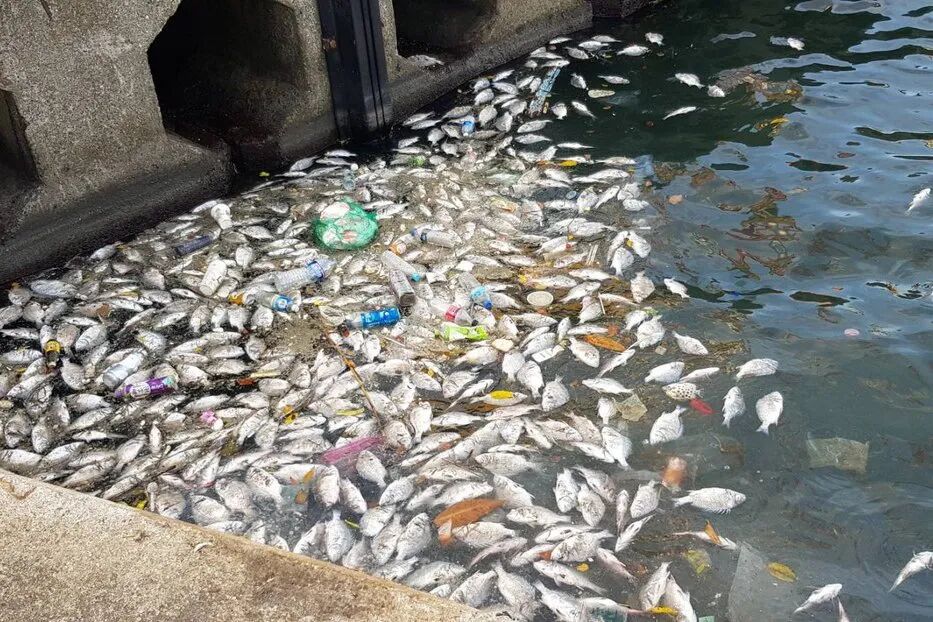
Fish killed by being released.
The present fashion for mass release — freshwater fish tipped into the sea, a land tortoise thrown into water, hundreds of turtles into one small temple pond until the temple puts up a notice saying the pond is full and please stop — is not release. It is killing. Release in moderation, in the right quantity, and with some understanding of what you are doing.
11. Adjusting the six relations
Changing your own field by changing the people closest to you.
This covers not only relatives but close friends. Which is the principle that a person can kill a person. Among your friends, one is somehow there to help you and another is somehow there to harm you: go out with the first and things go well, go out with the second and they go badly. You may keep the second as a friend; keep your distance.
Principle five: conversion of energy
A disaster is an abnormal quantity of energy. Resolving it means draining and discharging that quantity. Conversion means turning the abnormal energy into ordinary energy by a set route — draining rather than defeating. This is entirely unlike external aid, which is a contest of strength.
Bloodshed. Its defining feature is loss of blood. Blood can be lost by donation, by injury, by blood disease. Predict a bloodshed month and you can go and donate on the first day of it, more than once, converting a malignant bloodshed — injury, or blood disease — into a benign one: blood given, a life saved.
Loss of money. Its defining feature is that money leaves your hands. It can leave by theft, robbery, fraud, loss, damage, medical bills, celebration, lending, donation. There is bad loss and good loss. By the conversion principle you pre-empt it: lose the money deliberately, and lose it well. Lend to a reliable institution or a reliable friend. Donate. Buy fixed assets that do not deteriorate. Bring a celebration forward. Convert the energy of bad loss into good loss in advance. Bad loss is pure waste; money donated resolves the disaster, helps someone, earns merit, and earns reputation. Then be careful in your financial dealings. The disaster is converted and the theft, the robbery, the fraud, the hospital bill do not arrive.
And yet most people would rather lose badly than lose well, which is exactly why most people's disasters cannot be resolved.
The old saying is that losing money buys off disaster. That is the conversion of fate-energy. Every person is a vehicle with a fixed load capacity. Overload it and faults appear continuously. The gentleman's advantage is that he knows his fate — knows what kind of vehicle he is and what his capacity is — and learns to set down some of the cargo so that the vehicle lasts longer and goes further. “Losing money buys off disaster” is not psychology. It is physics.
Of all the methods, conversion is the most fundamental, the most direct, the most effective, and the easiest for people to accept.
Resolving disaster is a scientific doctrine consistent with materialist dialectics; and only a method consistent with materialist dialectics can resolve every disaster it meets.
Source:WeChat public account “Shikongren Coordinates” (时空坐标) · by Lü Wenyi
Chinese original:解灾技术五大原理概述
Notice:This is a study archive. Copyright remains with the author. Nothing here constitutes advice.