What Is the Astronomical Origin of the Ten Heavenly Stems?
Translator's note. This article belongs with the three that follow it. Together they answer a single question: what are the Stems and Branches made of? The answer given here is astronomical, not symbolic — the ten Stems are read as ten configurations of Jupiter, Saturn, Earth and the Sun. Readers who have met the Stems only as “Yang Wood is a tall tree, Yin Wood is a flower” should expect that reading to be dismissed, politely at first and then not politely at all. The original contains a passage cursing named and unnamed plagiarists in extremely violent language (premature death, dismemberment, the extinction of one's descendants). It has been condensed into a single sentence. The argument does not depend on it.
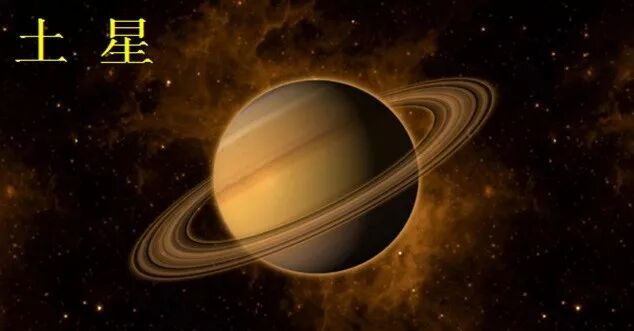
Saturn was called zhenxing, “the garrison star”, in ancient China. It is one of the eight planets and the second largest in the solar system.
On the question of the Heavenly Stems, modern astronomy has established something specific: of all the planets, the two that most affect life on Earth are Jupiter and, after it, Saturn. The relationship between the two is called, in astronomy, the Jupiter–Saturn system — and that system exerts a substantial influence on terrestrial life.
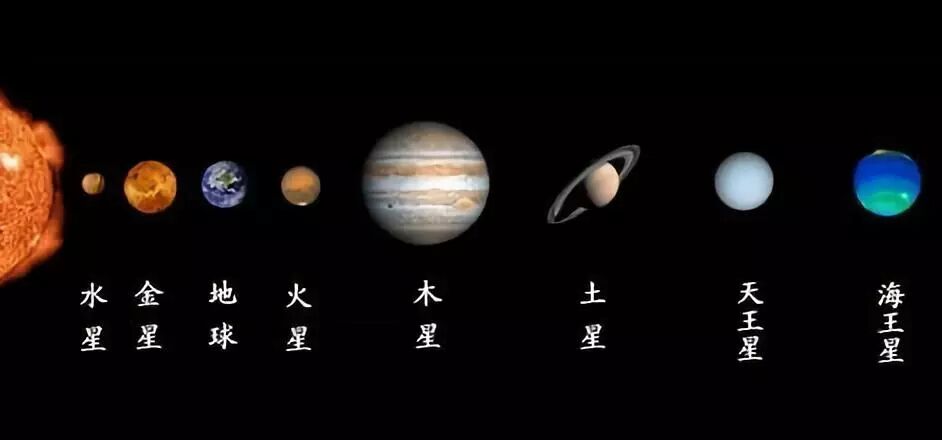
Saturn's orbital period is 29.5 Earth years, roughly thirty. Jupiter's is twelve. The ratio between them is five to two.
A striking consequence follows. Roughly every ten years, Earth, Jupiter, Saturn and the Sun fall essentially into a straight line. This is what the concordances of the ten Heavenly Stems describe. (See the diagram below.)
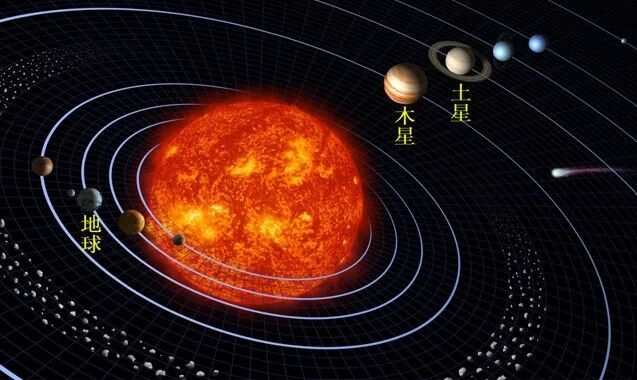
Every five years, Jupiter and Saturn sit on opposite sides of the Sun. (See below.)
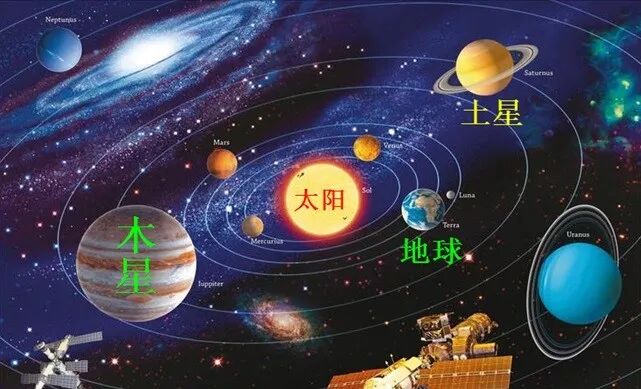
Jupiter is the largest planet in the solar system, so its influence on Earth is the greatest. Saturn is the second largest, so its influence is second.
When Jupiter, Saturn, Earth and the Sun form a line, their combined gravitational field acts on Earth in a way that matters — and life on Earth is affected accordingly. That, in fact, is where the ten Heavenly Stems come from. Once this is grasped, the question of which Stems combine and which clash resolves itself: why there are five concordances and four clashes among the Stems stops being an arbitrary rule to memorise and becomes a consequence.
It also explains why a reading can be done from the Stems alone, without the Branches. Take a bing-shen year. Working only from the bing fire, one can still say a great deal about the people born in that year — but what one is describing is the shared fate of everyone born under that configuration. What the Stems alone cannot do is distinguish one such person from another.
And here we must be blunt about a widespread misreading. The Stems are not what the popular books say they are — jia wood as a towering tree, yi wood as a delicate flower. That is a corruption of the system. You may, if you like, describe the Stems as a life cycle; as poetry it is harmless. But if you use that picture to do a reading — if you think of the Stems and Branches as a narrative of growth and decay — then your entire mode of reasoning has already gone wrong, and you will never be able to explain why two people born in the same year, month, day and hour nonetheless live different lives.
Only when you treat the Stems and Branches as different intensities of energy acting in different ways does that problem become solvable.
Anyone studying this system has to go down into its nouns and concepts. Stay at the level of the humanities — treat the system as literature, as culture, as a way of talking about life — and the result is self-deception. You will not understand why a reading sometimes hits and sometimes misses. When you sit in front of a client and get something exactly right, and then get the next thing wrong, you will have no idea why, and your practice will remain a cat chasing a mouse.
Once the nature of the four-pillar chart is clear, the rest follows. Take any combination of Stem and Branch — jia-zi, say. If it appears as a year, it denotes one particular arrangement of Earth, Sun, Jupiter and Saturn; you could locate those four bodies in the sky at that moment. If the year is yi-chou, that denotes a different arrangement.
Different arrangements mean that every living thing on Earth receives the “primordial life energy” of the cosmos at a different intensity and through a different mode of action. Because the positions of Earth, Sun, Jupiter and Saturn differ from year to year, people born in a jia-zi year, a yi-chou year and a bing-yin year differ enormously in their fates.
A year denotes the broad positional relationship among these four bodies.
A month — say bing-yin through ding-chou within a jia-zi year — denotes twelve finer variations inside that broad relationship. This is why people born in the same year but different months receive the energy at different intensities and in different modes, and why their fates diverge substantially.
A day and an hour work the same way at a still finer scale. People born in the same year and month but on different days, or at different hours, receive the energy differently again, and their fates differ accordingly.
The Chinese original inserts here a long passage cursing plagiarists of the author's work, promising them early death, mutilation and the end of their family line. It is omitted.
When a person's four pillars are written out, one can mark on a single diagram exactly where Earth, Sun, Jupiter and Saturn stood during the two-hour window of that person's birth. This is the shared component of fate among people born in the same year, month, day and hour — and it is why a chart can be accurate at all. Different charts give different fates.
So why is a chart not accurate? Because everyone born in the same year, month, day and hour occupies a different spatial environment. Different environment means a different intensity and mode of reception of that same cosmic energy, and therefore a different fate.
It is raining outside. One man is indoors; another is in the yard. The man indoors receives only damp air. The man in the yard gets soaked, and catches cold. Same rain, same hour, different outcome — because the receiving environment differed.
That is the root of why the chart alone is never enough.
Source:WeChat public account “Shikongren Coordinates” (时空坐标) · by Lü Wenyi
Chinese original:十天干的天文学科学来源是什么?
Notice:This is a study archive. Copyright remains with the author. Nothing here constitutes advice.