What Is the Astronomical Origin of the Twelve Earthly Branches?
Translator's note. The companion piece to the previous article. Where the ten Stems track the Jupiter–Saturn alignment, the twelve Branches track Jupiter alone. Read together they make a single claim: the sexagenary cycle is not a convention that happens to have survived, but a record of two planetary cycles and the way they interlock.
The twelve Earthly Branches were fixed by the ancients from the motion of Jupiter. Jupiter's orbital period around the Sun is twelve years; Chinese astronomy calls the planet suixing, “the year star”, or taisui — and the twelve-Branch count is the same twelve years. (The figure shows Jupiter's position within the solar system.)
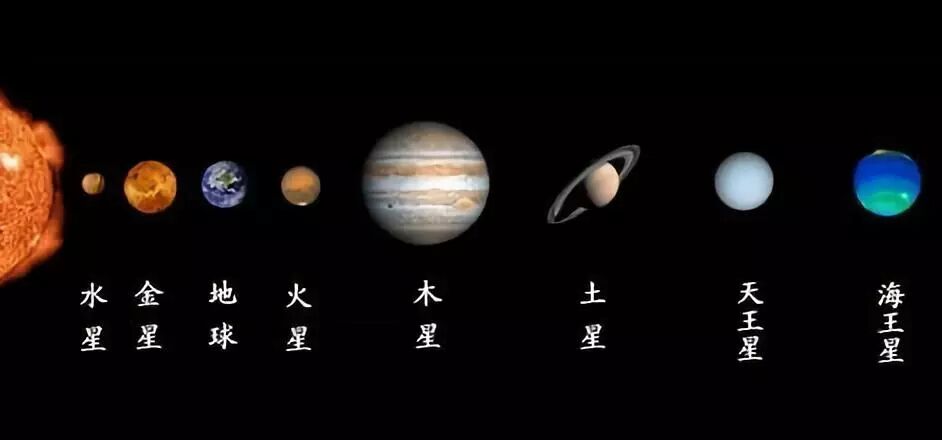
But why did the ancients insist on watching Jupiter in particular? Why use the relationship between Earth and Jupiter as the key to how the ten thousand things on Earth arise, develop and change?
Modern astronomy gives a scientific reading of that choice. Jupiter is the fifth planet outward from the Sun, and by a wide margin the largest of the eight.
Among the eight planets, Jupiter has the greatest volume and the greatest mass. Its mass is more than two and a half times the combined mass of all the other seven. It is 318 times Earth's mass and 1,321 times Earth's volume. It is the fourth brightest object in the sky, behind only the Sun, the Moon and Venus — though at times it appears dimmer than Mars, and at other times brighter than Venus itself.
But the decisive fact is this: Jupiter's immense gravity intercepts roughly 99 per cent of the asteroids and comets — coming from beyond the solar system and from within it — that would otherwise threaten Earth. It has created a safe environment for life to evolve here. By astronomers' calculations, without Jupiter the rate of impacts on Earth would be more than a thousand times what it is today. Without Jupiter there would have been no life on Earth at all; and even if life had appeared, it could not have persisted. Jupiter is the umbrella over terrestrial life.
Ranked by influence on Earth: the Sun first, the Moon second, Jupiter third.
The twelve Earthly Branches come from exactly that twelve-year period. And here it is worth being precise, because almost everything written for a popular audience gets it wrong. The sequence zi, chou, yin, mao, chen, si, wu, wei, shen, you, xu, hai is not a dramatisation of the twelve zodiac animals. Nor is it the ancients' claim that zi stands for a rat that comes out at midnight, that chou stands for an ox, or anything else of that kind. Those are illustrations of the sequence, nothing more — pictures attached to it after the fact to help people remember the order.
What the twelve Branches actually denote is the relative positional relationship among Jupiter, Earth and the Sun.
When that three-body geometry differs, the “primordial life energy” arriving from the cosmos reaches Earth with a very different intensity and through a very different mode of action — precisely because Jupiter is standing somewhere else.
Since the intensity and the mode of that energy differ from one year to the next, the ancients broke the cycle of Jupiter, Sun and Earth into twelve types, twelve configurations. A person born in one year therefore receives the energy differently from a person born in the next, and differently again from a person born in the year after that. This is why those born in a zi year, a chou year and a yin year are not the same in their fates.
And that — not the animal pictures — is the root of why the zodiac sign carries any information at all.
Source:WeChat public account “Shikongren Coordinates” (时空坐标) · by Lü Wenyi
Chinese original:十二地支的天文学科学来源是什么?
Notice:This is a study archive. Copyright remains with the author. Nothing here constitutes advice.