Locating Body Parts in a Bazi
Translator's note. The body map. If a bazi is a mould and a person is the product, this is the page that tells you how to inspect the product: which pillar governs which region, which stem the left side and which the right, and a long inventory down to individual fingers. Only nine features are needed to read a whole life; the rest come into play at the finer time scales. The closing argument — that cosmetic surgery changes a fate — follows directly, and is the most testable claim in the corpus.
To judge which direction the fate-energy of people born under the same bazi has been expressed in — wealth, office, study, marriage, children — we need the positioning of body features against the chart.
In practice, this positioning has proved fairly accurate.
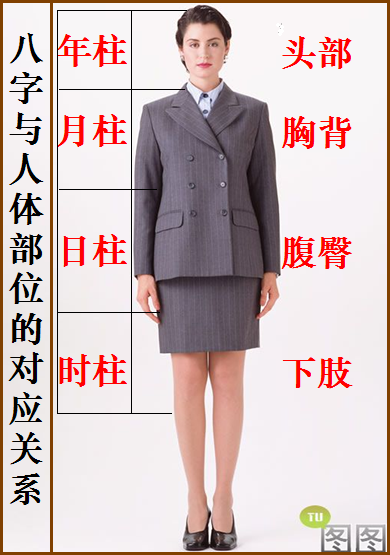
1. Platform positioning
- Year pillar: the head
- Month pillar: the chest, back and upper limbs
- Day pillar: the abdomen, waist and buttocks
- Hour pillar: the legs
2. The correction system
(1)
- Heavenly stems: the left side of the body
- Earthly branches: the right side of the body
- Heavenly stems: the front of the body
- Earthly branches: the back of the body
(2)
- Year stem: the crown; year branch: the jaw
- Month stem: the chest; month branch: the back
- Day stem: the upper abdomen; day branch: the waist
- Hour stem: the thigh; hour branch: the calf
- Hour stem: the arch of the foot; hour branch: the sole
- Day stem: the lower abdomen; day branch: the buttocks
- Year stem: the front of the face; year branch: the back of the skull
(3)
- Year pillar: the forehead; month pillar: eyes and ears
- Day pillar: the nose; hour pillar: the mouth
- Year stem: left forehead; year branch: right forehead
- Month stem: the eyebrows; month branch: the eyes
- Month stem: the eyes; month branch: the ears
- Day stem: the nose; day branch: the cheeks
- Month stem: left eyebrow; month branch: right eyebrow
- Hour stem: the mouth; hour branch: the chin
- Month stem: left ear; month branch: right ear
- Month stem: left eye; month branch: right eye
(4)
- Year pillar: the neck; month pillar: the upper limbs
- Day pillar: chest and back; hour pillar: the centre of the chest and both flanks
- Month stem: left upper limb; month branch: right upper limb
- Day stem: left pectoral (breast); day branch: right pectoral (breast)
- Month stem: left shoulder; month branch: right shoulder
- Day stem: left shoulder blade; day branch: right shoulder blade
- Hour stem: the centre of the chest; hour branch: both flanks
- Hour stem: left flank; hour branch: right flank
(5)
- Year pillar: upper abdomen; month pillar: navel and mingmen
- Day pillar: lower abdomen and buttocks; hour pillar: genitals and anus
- Year stem: left upper abdomen; year branch: right upper abdomen
- Month stem: the navel; month branch: the mingmen (the small of the back opposite the navel)
- Month stem: lower abdomen; month branch: buttocks
- Day stem: left lower abdomen; day branch: right lower abdomen
- Day stem: left buttock; day branch: right buttock
- Hour stem: genitals; hour branch: anus
(6)
- Year pillar: the thigh; month pillar: the knee
- Day pillar: the calf; hour pillar: the foot, including the ankle joint
- Year stem: left thigh; year branch: right thigh
- Year stem: front of the thigh; year branch: back of the thigh
- Month stem: the kneecap; month branch: the popliteal fossa, behind the knee
- Month stem: left knee; month branch: right knee
- Day stem: left calf; day branch: right calf
- Day stem: front of the calf; day branch: back of the calf
- Hour stem: the ankle joint; hour branch: the foot
- Hour stem: the arch; hour branch: the sole
- Hour stem: left foot; hour branch: right foot
(7)
- Year pillar: the shoulder; month pillar: the upper arm
- Day pillar: the forearm; hour pillar: the hand
- Year stem: left shoulder; year branch: right shoulder
- Year stem: front of the shoulder socket; month branch: back of the shoulder socket
- Month stem: left upper arm; month branch: right upper arm
- Month stem: outer upper arm; month branch: inner upper arm
- Day stem: left forearm; day branch: right forearm
- Day stem: outer forearm; day branch: inner forearm
- Hour stem: left hand; hour branch: right hand
- Hour stem: back of the hand; hour branch: palm
- Hour stem: the palm; hour branch: the fingers
- Hour stem: left fingers; hour branch: right fingers
- Hour stem: outer fingers; hour branch: inner fingers
To make this easy to remember, I have gathered the above into a table for students.
Year stem: left forehead, front of the face, left rear skull, front of the neck, left front of the neck, right back of the neck, left shoulder, front of the shoulder socket, left front of the shoulder socket, left back of the shoulder socket, upper abdomen, left thigh, front of the left thigh, back of the left thigh, front of the thigh, side of the wrist joint, left wrist joint, back of the left wrist joint, front of the left ankle, back of the left ankle, outer left ankle, inner left ankle, outer left ankle.
Year branch: jaw, back of the skull, back of the neck, back of the lower spine, right thigh, right wrist, left forehead, back of the skull, right side of the skull, back of the neck, front of the neck, right back of the neck, right shoulder, back of the shoulder socket, right front of the shoulder socket, right back of the shoulder socket, back of the abdomen, back at the heart, right thigh, front of the right thigh, back of the thigh, inner side of the wrist joint, right wrist joint, back of the right wrist joint, inner right wrist joint, back of the ankle, right ankle joint, front of the right ankle joint.
Month stem: eyebrows, outer ear, left arm, navel, knee, brow and eye, front of the chest and neck, left eyebrow, left eye, left ear, left arm, left upper arm, left back, navel, left waist, left front of the waist, left back of the waist, right knee, right kneecap, left popliteal fossa.
(Left, right, front, back, inner and outer are assigned by the student.)
Month branch: eyes, inner ear, right arm, mingmen, popliteal fossa, ear, back of the neck, right eyebrow, right eye, right ear, right arm, right upper arm, right back, mingmen, right waist, right front of the waist, right back of the waist, right knee, right kneecap, right popliteal fossa.
(Left, right, front, back, inner and outer are assigned by the student.)
Day stem: height, weight, complexion, nose, chest (breast), belly, calf, left calf, weight, complexion, nose, left cheekbone, left chest (breast), left shoulder blade, left forearm, belly, left calf, left buttock (lower back).
(Left, right, front, back, inner and outer are assigned by the student.)
Day branch: body colour, cheekbone, shoulder blade and back, buttocks, right calf, right forearm, right cheekbone, right chest (breast), right shoulder blade, right forearm, lower back, right buttock, right calf (buttock).
(Left, right, front, back, inner and outer are assigned by the student.)
Hour stem: mouth, the hollow of the chest, genitals, left foot, arch, left hand, mouth, lips, upper teeth, hollow of the chest, left flank, lower left back, genitals, left foot, left sole, left lower limb, arch.
(Left, right, front, back, inner and outer are assigned by the student.)
Hour branch: teeth, ribs, anus, right foot, sole, right hand, cheek, lower teeth, right flank, lower right back, anus, right foot, right arch, right sole.
(Left, right, front, back, inner and outer are assigned by the student.)
Every stem and branch in a bazi stands for several, even a dozen, body parts. When predicting the auspicious and inauspicious course of a whole life, only nine features are examined: height, crown, jaw, chest (breast), back, abdomen, waist and buttocks, arch, sole. All the other body parts a stem or branch stands for are used in reading specific events in annual, monthly and daily cycles. The relation between the annual cycle and the monthly and daily cycles is the relation between a large region of the body and the smaller regions it contains, and those in turn and the smaller still. Seeing this great inventory of parts, you may think the positioning cannot be applied in practice. In fact it is very simple to apply.
Even twin sisters, whose skull shapes are much alike — if the elder has had jaw surgery and the younger has not, their fates will diverge. By the same token, double-eyelid surgery, dyeing the hair, breast enlargement and buttock enhancement also change a person's fate.
Cosmetic surgery can change fate. What matters is getting it right: kill an unfavourable god by surgery and the fate moves in a good direction; kill a useful god and it moves in a bad one. Which it is depends on the ten god occupying that part. In real life, after cosmetic surgery some people die, some divorce, some go bankrupt, some fall ill — and the bazi model theory accounts for this better than anything else.
The positioning system is the golden key to the differing fates of five-fold and six-fold coincidences, and it matters a great deal.
In my own readings I have judged that a certain man must either have had a tooth out or be constantly knocking his teeth; I have judged another man to have a hernia. Both came from the positioning system, not from the ten gods.
If reading a fate covered only what is common, there would be no need to study this system at all. Every theory of bazi prediction except mine studies the commonality of fate; nobody studies its individuality. They try, but their theory is not built on a platform from which individuality can be solved. I do not say my theory is the best, but at least it can be said to be closer to the truth.
Through these three levels of division, the differing fates of five-fold and six-fold coincidences can be fully separated. The day branch, for instance, is the spouse's position and its location is the buttocks. If your day branch is the useful god, and your day branch is weak, and your buttocks have grown large and heavy, then your wife is either ugly or a painted pillow good only to look at. From the size of a man's buttocks we can rank the quality of the wives of all fifteen hundred men born under one bazi. The hour pillar is the children's position; likewise, from the feet we can judge the children of each person born under one chart, and judge whether a person's fate-energy has been expressed in his children. All of this holds in theory and stands up to practice.
Source:WeChat public account “Shikongren Coordinates” (时空坐标) · by Lü Wenyi
Chinese original:人体部位在八字中的定位
Notice:This is a study archive. Copyright remains with the author. Nothing here constitutes advice.