The Positioning System of a Bazi
Translator's note. The technical centre of the whole Bazi corpus. A chart, Lü says, carries two sets of ten gods: the ones you can see in the four pillars, which he calls the clothing system, and the ones hidden underneath, which he calls the positioning ten gods or the body. Reading the clothes is what the trade does, and it is why the trade needs the fictions of “special charts,” “following structures” and “transforming structures” — every chart that does not fit gets reclassified instead of re-read. Two people born under four identical wuwu pillars, one small and clever in Hainan and one huge and dull in Henan, are the demonstration.
Every bazi is in fact made of two systems: the surface ten gods and the positioning ten gods. The surface ten gods can be pictured as a person's clothing. The positioning ten gods can be pictured as the person's body.
1. The positioning standard linking a bazi to the six relations
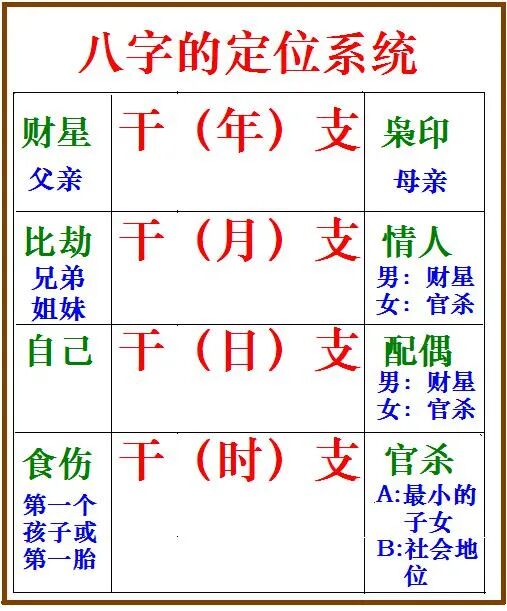
2. The positioning standard linking a bazi to the positioning ten gods
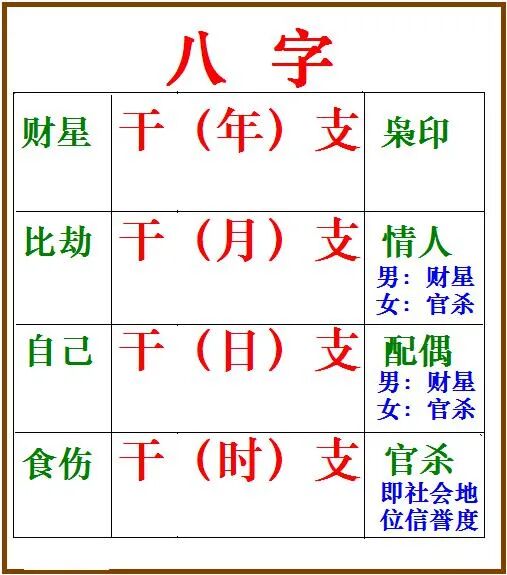
3. What the positioning ten gods are
The positioning ten gods are the stems and branches hidden beneath the visible stems and branches of a chart — the ones that carry the essential human attributes of year, month, day and hour.
Any bazi we look at is that person's clothing system. To see what a person is once the clothes are off, we judge by the positioning of the ten gods.
A male chart: Jiashen, Yiwei, Jiayin, Xinwei — this is the clothing system.
Wuzi, Yiwei, Jiachen (Xu), Bingshen — this is the body system.
Take the four wuwu charts below as an illustration.
| (clothing) | (body) | |
|---|---|---|
| (Ren) Wuwu (Wu) | Renwu | |
| (Wu) Wuwu (Zi) | Wuzi | |
| (day master) Wuwu (Zi) | Wuzi | |
| (Geng) Wuwu (Yin) | Gengyin |
Why does this idea hold? Because if a person is standing in front of us alive, it means he has already adapted to being roasted by four fires. He has adapted to bathing in fire every day. He has adapted to washing in fire rather than in water. He is a man whom fire cannot kill — and if fire cannot kill him, then whether he “follows” or “does not follow” is beside the point.
If the person is dead, it means he could not withstand the roasting of those four fires. Every bazi has people who die at birth, and every bazi has people who live to eighty. Tally the records of every maternity hospital in the country and you will find that in every single hour a child is born and then dies. That is to say: within any one bazi there is someone who dies at birth, someone who dies at one, someone who dies at two, someone who dies at three.
Suppose this were Lord Guan's chart. When would Lord Guan die? Lord Guan dies in the years that fear fire.
Reading fortunes from the clothing system does have a certain accuracy. Women generally wear skirts; women generally keep their hair long; women generally wear earrings. See a white coat and you can be fairly sure the wearer is one of four things: a doctor, a cook, a barber, or someone in mourning for an elder. But you cannot say that everyone in a white coat is certainly a doctor — that habit of judgement is simply wrong. The clothing system cannot deliver precision.
Stare only at the surface and your accuracy will be very low. Should you then stare only at the body system? No. The scientific method is to combine the two.
Do you know why you cannot read accurately? Because you have been judging a person's wealth and rank, marriage, children and health from their clothes and accessories, and the error rate of that method is enormous. Plenty of frauds are paupers whose clothes, watches, rings and cars are all famous brands. A woman's clothes may suggest a full figure; undressed, she may be an airfield. Does carrying an official seal make a man an official? He may be the office messenger.
It is precisely because traditional fate studies read only the clothing system and never the body system that it has invented “special charts,” “ordinary charts” and “following structures.” All of these are absurd.
There are no special charts. Of the people who write books and the people who read fortunes, eighty per cent of those who speak of “special charts” are charlatans. Why? Because the word special has a powerful effect on a client's psychology, and with it a man can become a top-level master without learning any theory at all.
First, psychologically, everyone believes himself special — the official, the labourer, the beggar, the childless, the healthy, the disabled.
Second, once the client accepts that he is special, the master has struck gold. Because the client is special, even a wrong reading lays a solid foundation for charging again. Because the client is special, the master can try a reading: hit, and the client thinks him formidable; miss, correct it, and the client still thinks him formidable. With the word special plus a little reading of faces, you can fleece clients without studying any predictive theory whatsoever.
Why do we study predictive theory? Because we genuinely want to understand why our fate is what it is, and how we can move toward the auspicious and away from the inauspicious. Researching fate and working as a reader is not only about handling clients and making a little money. Turning our fate for the better is the fundamental purpose. If you can understand your own fate, you can act, do business and earn according to your own situation; you need not earn your money from clients' fees. Why can we not do that? Because our predictions cannot reach the precision of “tomorrow I will certainly make money.”
There is no special chart and no ordinary chart. Any chart can produce an emperor; any chart can produce a beggar. Charts are not good or bad. Take commodities: exchange value can be compared, use value cannot. You cannot say a screw is of small use and a car of great use. A thing of great value is not necessarily of great use at a particular time and place. Heaven gives each of us a use; a person who puts himself in the right position at the right time has a good fate. If you were the screw holding the portrait of the great leader above Tiananmen, would you know how glorious you were?
A bazi has no special charts. At most it has people wearing special clothes. It has no special people.
The positioning system of the ten gods is a matter of the first importance and must be memorised. Otherwise, the moment you meet what everyone calls a “special chart,” you will be unable to read it at all.
There was a typist at the Li Hongcheng company in Hainan whose bazi was four wuwu. Every master judged that in the zi year of 1996 this boy would suffer disaster himself or his parents would. The reasoning: zi and wu clash; water excites fire. In fact nothing whatsoever happened to him or his family in 1996. Every master was wrong — and having been wrong, they filed the chart under “special.” The boy was from the northeast, small and slight, a graduate of a technical secondary school in computing; both parents worked in offices. Some years later a master of the eight-mansion school and blind-school bazi in Henan supplied another four-wuwu chart. That man was his neighbour: tall, big-framed, thick-set, a little simple, a farmer who worked the land at home and could not even find a wife. Two identical charts, two utterly different outcomes — because in one the unfavorable god was active and in the other it was not. There are no special charts. A bazi is the coat worn by a person's inner quality of fate. Do not be deceived by the coat; see through it to what the fate actually is.
Now the question of “following structures.” Whether the original chart follows strength or follows weakness is a secondary matter. A car fresh from the factory may genuinely have not one flaw in its paint. A car running on the motorway never does — even a small flying insect leaves its mark. No car is flawless when it leaves the plant. Once it enters the motorway of the luck cycle, and then the weather of the annual, monthly, daily and hourly cycles, flawlessness is beside the point. In other words: a following structure may exist in the original chart, but the moment the luck cycle begins, with its annual, monthly, daily and hourly variation, there is no following structure at all. A person does not live inside his original chart; a person lives inside his luck cycle and its years, months, days and hours. There is no need to research whether the original chart has a following structure.
“Transforming structures” are the same: there is no standard at all. How can you learn something with no standard? Different masters reach different conclusions on the same chart. We cannot say a thing without a standard is entirely wrong, but we can say it is highly arbitrary. Arbitrary things we cannot learn and cannot master. The best method is to abandon them.
Many habits of thought in traditional fate studies are wrong. Sink into the swamp of “special charts, ordinary charts, following structures, transforming structures” and you will never make a new breakthrough in predictive studies.
I did not once believe that bazi could read fate, because twins have different fates. Until I had thought through the “direction in which fate-energy is expressed,” I did not study fate theory at all. Later, having used that principle to solve the difference between five-fold and six-fold coincidences, I found that the “bazi model theory” predicted more simply and more accurately. That is how I came to it, step by step.
Before I studied feng shui, the first thing I studied was Qimen Dunjia. I borrowed a classmate's father's book in 1979. I did not go further with it, because in the course of study I found that Qimen has four great schools. First, at the stage of casting the chart, some “insert the intercalary month” and some do not — the question of how to handle leap months, since the lunar dates and the solar terms never quite line up, and in the end the Beginning of Summer wanders into winter, which is a complete inversion. Cast the chart for this very hour by the two methods and you may get two entirely different charts, and different charts give different readings. Then I found that within the intercalary school there are again the “flying palace” and “arranging palace” methods, and those two disagree as well. So I thought: if I were a murderer and went to consult four Qimen masters about which direction to flee so the police would not catch me, the four would tell me east, south, west and north — so which way do I run? Whom do I obey? It is very rare for four masters to agree. While the four of them argue, the client has already been ruined. That is why I did not go further with Qimen. I knew that no one could resolve the contradiction in casting the chart — not in the past, not now, not ever — because the theoretical system behind Qimen chart-casting cannot resolve it. So people who study Qimen have something wrong with their heads. On what basis do you claim your school is accurate and the other three are not? Nobody should take offence at this. What one should study is a predictive art whose theory has been consistent from antiquity to the present. Whichever school or art you study, if you can see where its defects lie and where its strengths lie, avoid the defects and use the strengths, you will still succeed in practice.
Having the ten gods in their proper positions matters greatly; the positioning ten gods help more than the surface ten gods. (Once a ten god loses its position its force diminishes — parents are constrained in their child's home; a rogue becomes obedient in a strange place.)
Only the body system is a person's fate. A doctor diagnosing a patient looks at the body, not the clothes.
Female chart: Renxu, Guichou, Jiawu, Guiyou
Water is the unfavorable god; this woman is short, and the gui water does good work. The positioning ten god beneath the hour stem gui water is bing fire, so she can also obtain the benefits that bing fire, the eating-and-wounding god, brings. Although gui water is the seal, her parents' situation should be analysed chiefly through the positioning ten gods. She should not wear high heels. A person's ability and bearing are what win people over, not appearance. Any change in the body signals what has happened to a person and what will happen.
Fat and thin are determined by the month stem.
Female chart: Dingsi, Renyin, Guichou, Renzi
This woman is plump; one may infer that during pregnancy her home and the ancestral grave had auspicious sand in the ren, zi and gui directions. Water is the unfavorable god. If she bears a child in a water year, the child will not do well. In a jia or yi year the child will be outstanding; in a yihai year, still not good. In a metal year, the child's first half of life is auspicious and the second half inauspicious. In a fire year: a bing year clashes away the unfavorable ren water — auspicious; a ding year combines with the unfavorable ren water — inauspicious. A child born in a year of the useful god is good; in a year of the unfavorable god, bad. The fact: the child was born in a guiwei year. In such a case the child will have problems; if the child turns out well, then the parents' marriage will meet serious obstruction. Separation resolves the marital disaster.
Source:WeChat public account “Shikongren Coordinates” (时空坐标) · by Lü Wenyi
Chinese original:八字的定位系统
Notice:This is a study archive. Copyright remains with the author. Nothing here constitutes advice.