The Five-Element Properties of the Twenty-Four Compass Directions
Translator's note. Feng shui divides the compass into twenty-four shan, “mountains” — that is, twenty-four sectors of fifteen degrees each. Twenty of them are named after Stems and Branches; the remaining four are named after trigrams. This short essay is about those four, and it makes a claim that runs against almost every feng shui manual in print. For readers new to the system: the eight Stems that can be used as directions are jia, yi, bing, ding, geng, xin, ren, gui; the twelve Branches are zi through hai; the four trigrams used here are qian (northwest), kun (southwest), gen (northeast) and xun (southeast). The table below the opening lines was added by the translator to make the argument easier to follow; the original states the same information in prose.
Jia, yi, yin and mao are Wood.
Ren, zi, gui and hai are Water.
Bing, ding, si and wu are Fire.
Geng, xin, shen and you are Metal.
Chen, xu, chou and wei are Earth.
That accounts for twenty of the twenty-four directions. The remaining four are qian, kun, gen and xun — and this is where the received tradition goes wrong.
| Direction | Half one | Half two | What the tradition says |
|---|---|---|---|
| Qian (northwest) | 50% xu (Earth) | 50% hai (Water) | “Metal” |
| Kun (southwest) | 50% wei (Earth) | 50% shen (Metal) | “Earth” |
| Gen (northeast) | 50% chou (Earth) | 50% yin (Wood) | “Earth” |
| Xun (southeast) | 50% chen (Earth) | 50% si (Fire) | “Wood” |
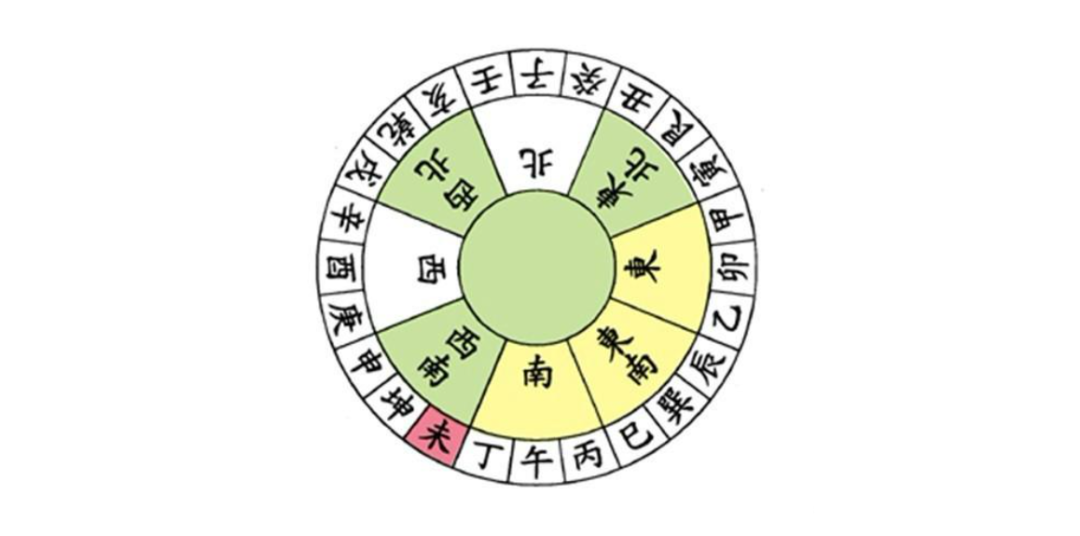
Qian is half xu and half hai. Kun is half wei and half shen. Gen is half chou and half yin. Xun is half chen and half si.
Remember this. Do not follow traditional feng shui and say “xun is Wood, qian is Metal, gen and kun are Earth.” Absolutely not.
Even if you go on practising traditional feng shui, once you return to what these four names actually contain, you will find your hit rate rising sharply. Considerably higher than when you treat qian as Metal — both when adjusting a site for someone and when calling outcomes.
Why are qian, kun, gen and xun not “Metal, Earth, Earth, Wood”? Let us go through it again.
The compass is divided into twenty-four directions. But only eight of the ten Stems can serve as directions, and only twelve of the twelve Branches. That leaves four short of twenty-four.
What did the ancients do? They noticed that in the eight trigrams qian sits to the northwest and xun to the southeast. So they took the names qian, xun, gen and kun and used them to stand for directions — not for elements. The four names were borrowed because they could denote those directions. That is all the borrowing was.
Nobody asks why four trigrams suddenly appear among twenty-four directions. Jia, yi, bing, ding are not trigrams. Why would the ancestors, who everywhere else speak in Stems and Branches and not in trigrams at all, suddenly produce four trigrams in this one place?
There is a reason. Return to the reason and you see it. Qian was borrowed to stand for a direction. Gen, xun and kun likewise.
The confusion is a confusion between a name and its function. A borrowed label is not a classification.
Source:WeChat public account “Shikongren Coordinates” (时空坐标) · by Lü Wenyi
Chinese original:风水上24个方位的五行属性
Notice:This is a study archive. Copyright remains with the author. Nothing here constitutes advice.