How Do You Read a Chart With Only One or Two Elements?
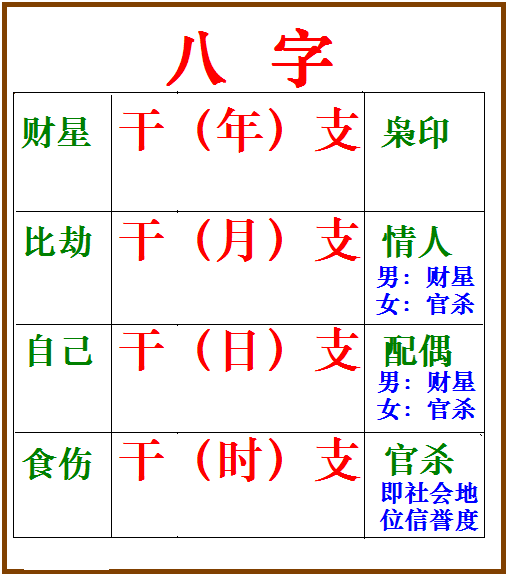
Translator's note. Two things to flag before you read. First, the “Ten Gods positions” table below is not the classical shishen system. In standard Bazi, the Ten Gods are derived relationally from the day stem against every other character, so which god appears in a given position depends on the chart. The table here assigns fixed meanings to positions — the year stem is always the Wealth position, the month branch is always the Lover position, regardless of what character sits there. This is the author's own “Bazi model,” and reading it as classical shishen will make the rest of the essay incoherent. Second, “special charts” (teshu mingju) is a real term of art in Chinese fate calculation, used for charts that break the normal patterns — one element only, or two. The author's argument is that the category is a confession of theoretical failure, not a description of rare cases.
In Bazi practice you will meet many charts built from a single element, or two, or three. Traditional fate calculation calls these “special charts” and reads them as exceptions.
But what is a “special chart”? I have put it this way: a “special chart” is a chart the masters cannot explain in theory and cannot predict accurately — it is the excuse they offer clients and readers, the loincloth they use to cover the fatal defect in their own system.
In reading fate there is no such division as special versus ordinary. If the theoretical system is scientifically correct, then every chart is an ordinary chart. Only when a system is flawed — congenitally, fatally flawed — does the category “special chart” have to exist.
Using our Lü Wenyi Bazi Model, a chart of one element, or two, or three is just an ordinary chart. There are no special charts. Whatever chart you face, memorise the following positional assignments and every chart becomes ordinary.
The Ten Gods positions
| Position | Represents |
|---|---|
| Year stem | The Wealth star position |
| Year branch | The Owl Seal (indirect resource) position |
| Month stem | The Parallel (peer/competitor) position |
| Month branch | The Lover position — and, for a woman, the Officer–Killing position |
| (also a secondary Parallel position; for a man, also a Wealth position) | |
| Day stem | Oneself |
| Day branch | The Spouse position — Officer–Killing for a woman, Wealth for a man |
| Hour stem | The Output (food/wounding) position |
| Hour branch | The Officer–Killing position, and a secondary Output position |
Memorise this and every chart is ordinary. The notion of a “special chart” disappears.
An example
Male: wu-wu / wu-wu / wu-wu / wu-wu — four identical pillars, 戊午 repeated.
From antiquity this has been treated as the textbook “special chart.” Virtually every system on record is helpless against it — the classic image is a dog trying to bite a hedgehog, with nowhere to start. Even the Ditan Sui — the eighteenth-century classic on Bazi — gives an account of this configuration that does not match the actual lives of the men who carry it.
I have been fortunate enough to meet two men with this exact chart. The first was a computer typist at Li Hongcheng's company in Haikou. Every master in that company read his chart on the spot. Not one got even a single event in his life right. The second was a neighbour of a friend in the Henan Yijing circle.
Read with the Bazi model, a chart like this is simpler than the charts the masters call ordinary. Here is the analysis.
Male chart:
- Year pillar: wu (Wealth position) — wu (Owl Seal position)
- Month pillar: wu (Parallel position) — wu (Lover / Wealth position)
- Day pillar: wu (self) — wu (Spouse / Wealth position)
- Hour pillar: wu (Output position) — wu (Officer–Killing position)
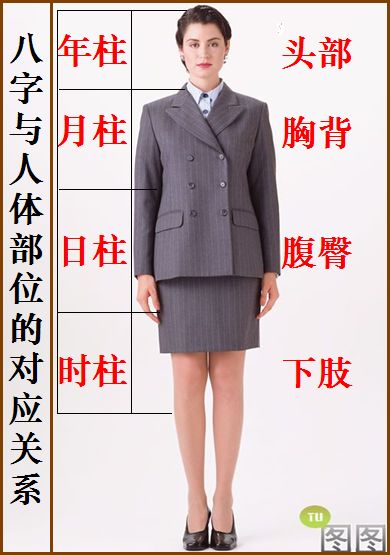
Once you see how the structure is built, you can assess the fate of any person carrying it — provided you also have the bodily facts: the nine regions of the body as they actually are in this person.
The typist in Haikou was under 1.70 m, thin all over, a vocational-school graduate, both parents working. The man from Nanyang in Henan was tall with a standard build, a farmer, who left school after primary, both parents farmers.
Same chart. Why completely different fates? Work through the chart's bodily signature and it comes clear.
1. Height
The day stem wu earth is strengthened by the month stem wu and the hour stem wu supporting it. A strong day stem implies a tall person. But earth is an unfavourable element (jishen) in this chart.
If this person is tall, then both the month stem and the hour stem — both unfavourable — have been doing their work. When the actual height matches the height implied by the unfavourable elements, that is already inauspicious. Add to it that the two unfavourable peers are actively supporting the day master: the hour stem sits in the Output position, so an unfavourable wu there means the Output position itself is unfavourable. An unfavourable Output position means this tall man not only lacks a source of income but will struggle to realise any ambition at all. The month stem sits in the Parallel position, unfavourable and active, which means a life of constant competition and loss. So for the tall man, wealth is very hard to reach.
Now suppose this person is short. Then the month stem and hour stem never actually came to the day master's aid — had they truly helped, he would be tall, not short. The fact of being short means they did not help. The hour stem is the Output position, and Output is unfavourable in this chart; if the unfavourable Output position did not act on him, then the Output position delivered its favourable function instead. Output favourable means he has a source of income, can realise his ambitions, and is content. The month stem sits in the Parallel position, also unfavourable, also inactive for a short man; Parallel governs competition, so this man rarely meets competition and things go relatively smoothly.
2. The crown of the head
Now the year stem wu earth. Its strength in this chart is “strong.” Earth governs squareness, so a strong year stem implies a square crown. But the short man in Haikou has a round crown — small, thin, round-headed.
The year stem is unfavourable; the crown implied by an unfavourable element is square. His is round. The fact contradicts the implication, so the fact is auspicious. And the year stem is the Wealth position — an auspicious Wealth position means this man will never be without money. The year stem is also the father's position, likewise auspicious, so he inherits from his father.
The tall man from Henan has a crown that is square-to-round, essentially matching the unfavourable implication. Fact matches, so the fact is inauspicious — the Wealth position is inauspicious, so throughout life money is scarce; the father's position is inauspicious, so no inheritance from his father.
From this I hope it is now entirely clear: there are no “special charts” in the world. There is only the falseness and error of chart-reading theories. There is exactly one kind of chart, the ordinary kind. The so-called special chart is simply a chart the masters cannot read and never could.
The Bazi model is scientific, materialist, dialectical, objective and grounded in reality. And once this is understood, three central questions in Bazi follow:
Why do people born at the same time — five or six of them, same year, month, day and hour — differ so much in fate? How can those differences be predicted accurately? And what, precisely, is the Lü Wenyi Bazi Model as a technique?
Source:WeChat public account “Shikongren Coordinates” (时空坐标) · by Lü Wenyi
Chinese original:命局只有一个或两个五行时怎么算命?
Notice:This is a study archive. Copyright remains with the author. Nothing here constitutes advice.