What Exactly Is the "Taiji Halo"?
Translator's note. This is the most technically important article in the feng shui group, and the one that repays careful reading. Its subject, the taiji yun (太极晕, “taiji halo”), is the faint circular mark that traditional site-finding treats as the signature of a true dragon point. The whole argument turns on a preposition. The modern masters say the halo is found inside the grave pit, after you dig. The author says the halo is on the open face of the hill, before you dig — and that the point is selected inside the halo, so the question “is there a halo in the pit” is not merely wrong but meaningless. The long passage quoted from Yang Junsong's Zangfa Daozhang (《葬法倒杖》, “Burial Methods and the Upright Staff,” attributed to the Tang master Yang Junsong, 杨筠松) is the textual basis, and we have translated it in full because the author's case rests on it. A few paragraphs naming living practitioners have been condensed; the technical content is intact.
Yang Junsong, Liao Jinjing, Zeng Wendi and Lai Buyi — the four patriarchs of traditional Chinese feng shui. What did they mean by the taiji yun, the taiji halo?
I do not need to hold forth on this myself. Let us first see how the self-declared “orthodox successors, umpteenth generation” of those four patriarchs explain it.
The stakes are not small. In traditional feng shui, if you do not know what the taiji halo is, then xunlong dianxue — “seeking the dragon, selecting the point” — cannot even be discussed. The halo is the most basic knowledge in the whole discipline. A site without a taiji halo is never a true dragon point. A master who does not know what the taiji halo is cannot possibly know how to select a point.
What the modern books say
One book, titled Xunlong Dianxue, says:
All things return to one taiji; each thing has its own taiji. The taiji is a solar halo; a halo is a blurred state. Every point has a taiji halo — it has shadow but no form, faintly swelling. Just outside the halo the ground rises slightly, like sand but not sand; just inside it sinks slightly, like water but not water. There are solar halos and lunar halos, full halos and half halos. At the centre of the halo the living qi is warm and moist — this is an auspicious site.
Having read that book cover to cover, I found that the author not only fails to explain how to seek the dragon and select the point, he cannot even explain what the taiji halo is. What he offers is copied out of the ancients. The book is assembled, not written.
A large volume titled The Theory and Practice of Ancient Chinese Feng Shui says:
The “parent mountain” is roughly the entrance to the vein. First look at whether the vein twists and rises; then examine closely whether the ridge where the vein splits and rejoins has lun and yun — wheels and halos. Where it rises and falls with a halo, the vein carries living qi, and the site is generally auspicious. Without it, inauspicious... The halo is the indistinct outline around the point, and it is by means of it that the point can be fixed.
Several hundred pages, and the title promises both theory and practice. Read it and you find excerpts from the ancients and citations of contemporaries. The author's own view of feng shui theory is negligible, and there is no substantive summary of practice anywhere in it. The contents have nothing to do with the title.
A third author, in books titled Chenxi Kanyu and Chenxi Feng Shui, writes:
The taiji halo, also called the taiji ring or halo circle, refers to the dim, faintly damp ring formed by the misty water-vapour that coils around the centre of the point. Because it is indistinct like the ring around the sun or moon, it is called the solar halo.
Everything in that book apart from the author's account of himself is assembled from other people's work, Chinese and foreign, ancient and modern.
The list of self-declared “orthodox successors,” “professors,” “experts,” “authorities” and “world number one feng shui masters” is long, and I will not go through it one by one. Their books are one of two things, and I have read all of them.
The first kind is written by men who are clever, who have mastered the art of fraud, and who know nothing whatever about seeking the dragon and selecting the point. In their books they quote the ancients word for word and never dare to render the taiji halo in modern language. The quotation is the disguise; they are bluffing the reader.
The second kind is written by men who half understand, cannot read the old books, do not know how to select a point, and are not even good at fraud. They render the taiji halo in modern Chinese as “a circular halo inside the point, resembling the taiji diagram.”
And then there are the pictures. The images below are what these masters present as the “taiji halo.” Their explanation: the kanyu practitioner identifies the place where the vein knots — the centre point — and this is called “selecting the point.” Dig three feet into a true point, and there the “taiji halo” (a ring like the taiji diagram) will appear.
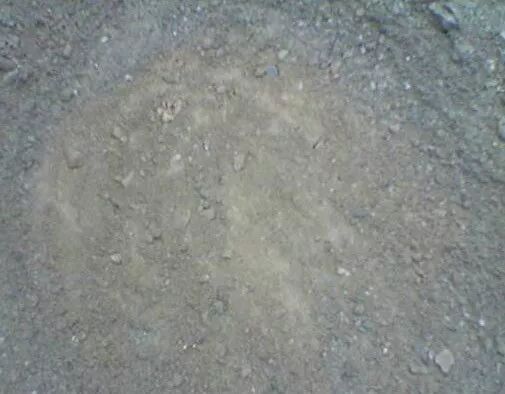
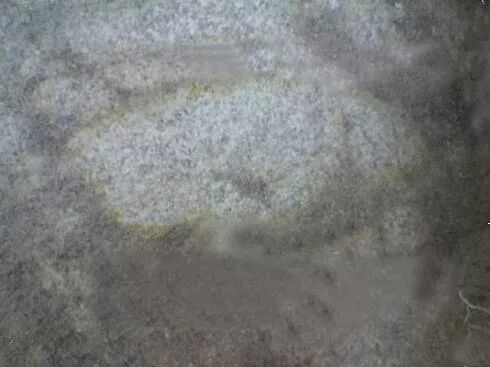
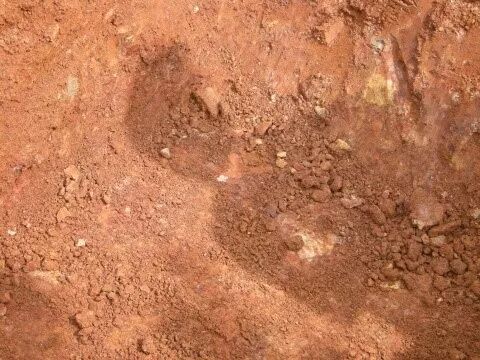
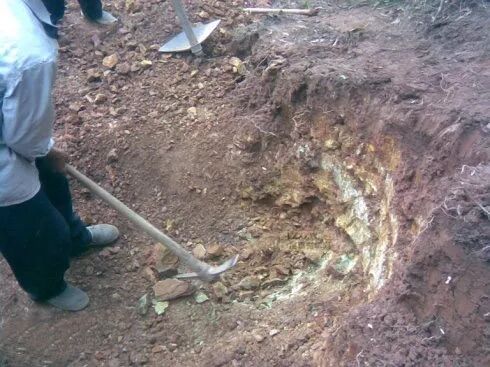
If those changes in the soil layers were the taiji halo, then anywhere at all, using only four variables — soil moisture, soil colour, soil horizon and soil texture — and a little digging technique, I could produce the masters' “taiji halo” 100% of the time, on demand, in any field in China.
That is a jianghu trick with almost no connection to real feng shui. Do not be taken in by it.
The category error
Here is why the whole modern reading collapses. As a master who writes books and takes students, you claim on one hand to be an expert in seeking the dragon and selecting the point. On the other hand you do not understand the most basic concept in that discipline. And without it there is no point-selection at all — because the point is selected inside the taiji halo. If you do not know what the halo is, you do not know where to place the point. And if you do not know where to place the point, what is the use of having found a true dragon?
So why do these men dare to write books, open schools, and select sites for clients?
Some readers will now ask: you have said all this, you have said every master alive misunderstands the taiji halo — are you the only one who understands it?
I am glad to be asked. Here is my answer. I have gone through every feng shui and Yijing website, blog and forum on the Chinese internet. Every explanation of the taiji halo given by every master who has a website or has ever posted under a name — every single one, without exception — is one of the two kinds above. I have gone through every contemporary book on feng shui in the market. Every single one, without exception, is one of the two kinds. I will not claim that I am the only person alive who has understood the question. But among all the masters who publish, teach and advertise, I am the one who understood it, and the first to explain it publicly.
Why put it that way? Because if you understood it and then explained it to your students wrongly — if your explanation cannot make the matter clear — then you did not understand it. And then you do not know how to select a point, and your practice is a con.
So what is it?
First, a historical claim. Every master before the Republic who wrote books and taught students knew what the taiji halo was. Not one master from the Republic to today who publishes and teaches has genuinely understood it.
Why? Because what the ancients wrote about the taiji halo is correct, without exception. And what has been written about it since the Republic is wrong, without exception. (Most of what is published in Hong Kong, Macao and Taiwan is wrong too. People there have a superstition about Hong Kong and Taiwan feng shui. In substance, what those places have is skill at operating on clients and extracting money. The real art is not there.)
Second, the explanation.
Yang Junsong's Zangfa Daozhang gives it in four stages.
Recognising the taiji
The xue field is bounded by the goldfish-water line. The round halo lying in the indistinct, faint zone — that is the taiji. Above it the water divides, faintly; below it the water joins, faintly. Where they join is the small bright hall, big enough for a person to lie on his side — that is the xue field. Where this round halo exists, living qi gathers within, and therefore it is a true point; the marker and the alignment are set by it. Without it, it is not.
Dividing the two modes
Within the halo, the sunken place is the yin point; the raised place is the yang point. These are the two modes. Where the point is made on the body of the vein itself, that is a yin dragon, and a yang point is appropriate. Where a separate star-peak rises and the point is made there, that is a yang dragon, and a yin point is appropriate. Both require reduction and addition. Sometimes the upper part is raised and the lower sunken; sometimes the lower raised and the upper sunken; sometimes left and right are raised and sunken in combination. In that case the two qi are felt together, and one takes the place where yin and yang copulate, where rising and descending meet — no reduction or addition is used.
Seeking the four images
The four images are mai, xi, wo and tu — vein, breath, hollow, mound. Mai is a faint ridge within the halo: the image of lesser yin. Xi is a faint form within the halo: the image of lesser yang. Wo is a faint hollow within the halo: the image of greater yin. Tu is a faint blister within the halo: the image of greater yang. For each of the four there is a burial method: for a mai point, fix the base at the centre; for an xi point, split it open and fix the base; for a wo point, raise it and fix the base; for a tu point, cut it flat and fix the base.
Multiplying by the eight trigrams
Where the vein is slow, use the Cover method: lift the coffin high, in the sense of covering over. Where the vein is urgent, use the Adhere method: place the coffin low, in the sense of sticking to it. Where the vein is straight, use the Lean method: place the coffin offset, in the sense of leaning against. Where the vein is neither urgent nor slow but transverse, use the Strike method: place the coffin straight in, in the sense of butting into it...
Read the text and the meaning is plain.
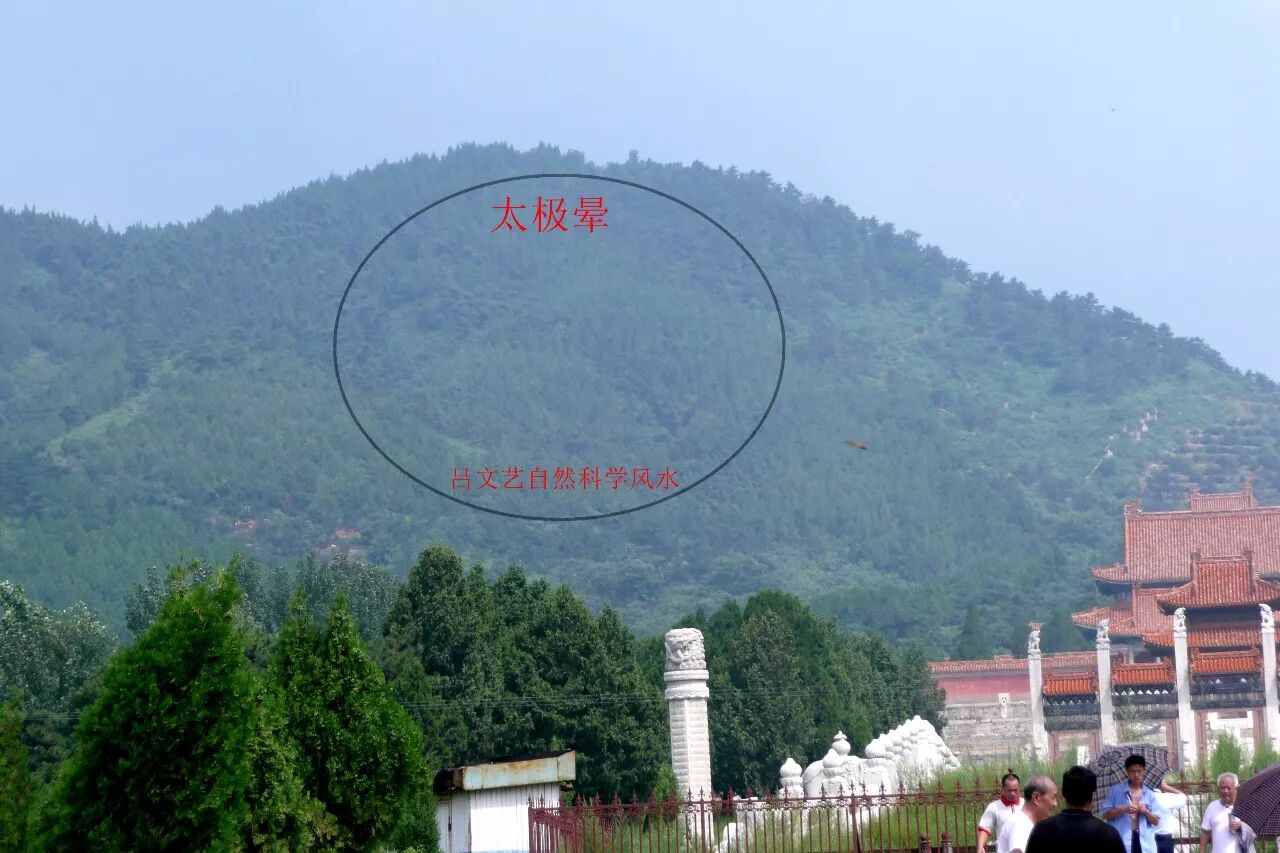
The taiji halo is a faint circular halo, roughly the shape of the taiji diagram, visible on the open face of the point-star hill where the dragon vein knots — seen by standing on the facing mountain opposite. That faintly visible ring is the taiji halo.
It has no fixed size. Large ones may be tens or even a hundred metres across; small ones may be one or two metres.
Within that halo, the sunken places are yin points and the raised places are yang points. Where the point is made on the body of the vein itself — a yin dragon — one should place the point at a raised yang position within the halo. Where a separate star-peak rises and the point is made there — a yang dragon — one should place it at a sunken yin position.
Where exactly within the yin or yang position to place it is then determined first by the four images — vein, breath, hollow, mound — which narrow the location, and then by the sixteen burial methods of the eight trigrams (cover, adhere, lean, strike; cut, intercept, drop, suspend; press close, merge, slant, insert; seek direct, prop, fold) which fix the precise spot.
That is the entire procedure of point selection. The whole procedure takes place inside the taiji halo. The true dragon point lies within the taiji halo — not the taiji halo within the point.
When the old books say “the taiji halo is the evidence of a true dragon point,” they mean: if the open face of the point-star hill carries a taiji halo, then the point made there is a true dragon point. They never mean: if there is a taiji halo inside the pit, then the point is a true dragon point.
A master who reads the old books at that level — what face does he have left to write books and take students? What capital does he have to boast of knowing how to select a point?
What the other old books say
Xu Shanji, Xuefa:
Turning back to look at the xue field, one sees a round halo between the faint and the visible; this is called the taiji halo — faint and slight, blurred and indistinct; looked at closely it has form, examined minutely it has none.
The sentence is a classical inversion: turning back to look at the xue field, one sees... It means: look back at the xue field — that is, look from the opposite direction toward the open face of the point-star — and a round halo appearing there between faint and visible is the taiji halo. It does not mean: look back into the pit and find a taiji halo there.
Xue field and inside the pit are two strictly different things. Today's masters cannot read classical Chinese. They take the words at face value, distort the old texts, mislead later students and do harm to their readers.
Kongshi Zhangzhe, Wuxing Timai Zheng Bian Ming Tu:
Once the xue field is fixed, one must first distinguish its taiji round halo...
Unambiguous. Having fixed the xue field, you must first find the taiji halo, and only then can you select the point. A xue field without a taiji halo has no true dragon point in it. The ancients said it plainly. The modern masters distort it into their own “the taiji halo is a round halo inside the pit.”
Liao Yu, Sixiang Zangfa:
The round halo within the xue is where the living qi gathers and the numinous light shows itself. The grave should be opened within the halo and must not be broken by the hoe; otherwise the living qi leaks away, the numinous light disperses, insects and ants enter the chamber, spring water invades the coffin, and the descendants are poor and cold.
Liao is telling us plainly: select the point and open the grave inside the taiji halo. As for “within the xue” — read in context it means within the xue field, at the open face of the point-star, not inside the pit.
Huang Miaoying (Song dynasty), Boshan Pian:
All the principles under heaven are yin and yang and the five elements, and yin and yang and the five elements never leave the circle. This circle is the aperture of life and death. Between heaven and earth there are small circles and large circles. Understand the circle and everywhere is a circle. The verse says: a round white jade circle, heaven turns and earth revolves of themselves; know the four flavours within the circle, and you are a walker of the earth among men.
“Know the four flavours within the circle and you are a walker of the earth among men” means: only one who understands the method of selecting a point by the four images — vein, breath, hollow, mound — within the taiji halo can be a true feng shui master.
Which is to say again: the point is selected inside the taiji halo; the taiji halo is not inside the pit.
The principle at stake
Read across the whole classical corpus and every old text says the same thing: the point is selected within the taiji halo; only a xue field that has a taiji halo has a true dragon point in it. No old text says: having selected the point, if there is a taiji halo inside it, it is a true dragon point.
This is a matter of principle in xunlong dianxue.
And the reverse claim is not merely unsupported, it is demonstrably false. A taiji halo inside the pit proves nothing, because at least 70% of all feng shui points have one. When you open a pit, you need only adjust your digging method and you can produce a “taiji halo” inside it 100% of the time. The halo in the pit is formed by four variables — soil colour, soil density, soil moisture, soil structure — and any one of them will produce it.
A true dragon point is not determined by soil colour, soil density, soil moisture or soil structure.
Understand that, and you understand: the halo inside the pit has no direct relation to a true dragon point. The true dragon point is inside the taiji halo.
If readers can grasp the essential meaning of the taiji halo, then the masters who publish, teach and cannot select a point may learn some humility and some ethics, and stop trading their descendants' prospects for fame and tuition money. And Yang, Liao, Zeng and Lai may close their eyes and rest.
Source:WeChat public account “Shikongren Coordinates” (时空坐标) · by Lü Wenyi
Chinese original:“太极晕”到底是什么?
Notice:This is a study archive. Copyright remains with the author. Nothing here constitutes advice.