How Sima Yi Knew from the Stars That Zhuge Liang's Time Was Up
Translator's note. A short piece of technical history rather than argument. The famous scene in Romance of the Three Kingdoms — Zhuge Liang reading his own death in the sky, Sima Yi reading Zhuge Liang's — is usually left unexplained by the novel. The explanation offered here is that both men were watching the same star, and that “watching the stars” in the old literature almost always means watching the Big Dipper, understood not as seven stars but as nine. The four rival naming systems for those nine stars are set out, since a Western reader will meet all four and assume they are different things.
In Romance of the Three Kingdoms, Zhuge Liang looks up at the sky and knows his own end is near; Sima Yi watches the stars at night and knows that Zhuge Kongming's allotted span has run out. The skill is enviable. What is disappointing is that the novel never says how — never explains what Zhuge Liang saw, or what Sima Yi saw. Readers have been left hanging for centuries.
For more than ten years I travelled to see good teachers, read the old books, and worked at the study of fate. Somewhere in the middle of it I found the secret of how the ancients watched the sky.
It is this. Beyond pure astronomy, whenever the heavens were read for the fate of a state or of a person, the observation was — apart from a few cases needing one particular star — almost always an observation of the change in the Big Dipper. This essay is about the Dipper only.
1. Seven stars, or nine
What we call the “seven stars of the Northern Dipper” is really nine. Beyond the seven usually seen there are two faint “hidden stars,” called Zuofu (Left Assistant) and Youbi (Right Assistant). With them the set is complete, and the nine are counted in order.
A reader who goes into the old texts will meet four separate sets of names. They are not four systems. They are four vocabularies for the same nine stars, and the correspondence is fixed:
| # | Direction | Ziwei (purple star) | Bazhai (eight houses) | Qimen (nine palaces) |
|---|---|---|---|---|
| 1 | North, water | Tanlang, the Greedy Wolf | Shengqi, Life Breath | Tianpeng |
| 2 | Southwest, earth | Jumen, the Great Gate | Tianyi, Heavenly Doctor | Tianrui |
| 3 | East, wood | Lucun, the Salary Store | Huohai, Harm | Tianchong |
| 4 | Southeast, wood | Wenqu, Literature | Liusha, Six Killings | Tianfu |
| 5 | Centre, earth | Lianzhen, Integrity | Wugui, Five Ghosts | Tianqin |
| 6 | Northwest, metal | Wuqu, Military | Yannian, Long Life | Tianxin |
| 7 | West, metal | Pojun, Army Breaker | Jueming, Severed Life | Tianzhu |
| 8 | Northeast, earth | Zuofu, Left Assistant | Fubai, Hidden Position | Tianren |
| 9 | South, fire | Youbi, Right Assistant | — | Tianying |
So the catalogue that runs “Tanlang, Jumen, Lucun, Wenqu, Lianzhen, Wuqu, Pojun”; the one that runs “Shengqi, Tianyi, Huohai, Liusha, Wugui, Yannian, Jueming, Fubai”; the one that runs “Tianchong, Tianren, Tianrui, Tianpeng, Tianying, Tianxin, Tianzhu, Tianfu, Tianqin”; and the one that runs “one white, two black, three jade, four green, five yellow, six white, seven red, eight white, nine purple” — all four name the same nine.
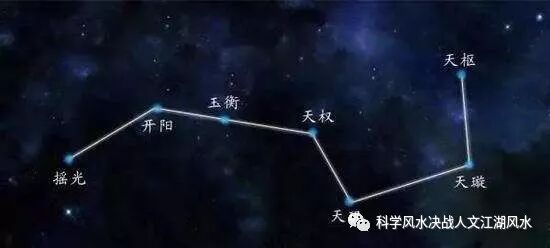
2. How the observation was made
The ancients held that each of the nine governs a different department of human affairs. To predict a given matter you first decided which star to watch; then you judged good or ill from how that star's light behaved.
If the star you were watching shone steadily and its light was bright and clear, the matter it governed would go well. If it was dim, lustreless, or its light was smothered by haze, the matter would go badly.
3. What each star governs
- Tianpeng — securing borders, building walls and cities
- Tianrui — teaching the way, making friends, lecturing, cultivating virtue
- Tianchong — going to war, taking revenge, bestowing favours, making friends
- Tianfu — seeking wealth, long journeys, marriage, building and burial
- Tianqin — sacrifices and prayers for blessing
- Tianxin — diagnosing illness and seeking medicine
- Tianzhu — concealing a trace, burying a form
- Tianren — meeting the powerful, negotiating
- Tianying — feasting, drinking, pleasure
4. Which star they were watching
From that list the inference is straightforward. Tianxin governs the diagnosis of illness and the seeking of medicine. Zhuge Liang watched Tianxin and knew his own end was near; Sima Yi watched Tianxin and knew Zhuge Liang's span was spent.
That is how the ancients did it: through exactly this kind of thought — seemingly precise, in fact blurred at the edges — observing the changes in the nine stars of the Dipper to read the fate of a state, or of a man.
Haikou, March 1999
Source:WeChat public account “Shikongren Coordinates” (时空坐标) · by Lü Wenyi
Chinese original:司马懿为何观星象而知诸葛亮气数已尽
Notice:This is a study archive. Copyright remains with the author. Nothing here constitutes advice.