Yin Dragons, Yang Dragons, the Open Face and the Taiji Halo
Translator's note. The practical companion to “What Exactly Is the Taiji Halo?” — same argument, this time walked through with reference to field photographs. The original is built around nine images: a yin dragon and a yang dragon, an open face, a taiji halo seen from the facing mountain, the sunken yin and raised yang positions within the halo, a halo in a pit (the error), the imperial tombs at the Eastern Qing tombs, and a diagram of the four images. Those photographs are reproduced at the points where the text refers to them. One passage of curses against plagiarists has been reduced to a note, per our usual practice.
Liao Yu's Sixteen Burial Methods pins down two things precisely.
First, the exact location of the point.
Second, the method of setting the orientation — and the orientation is set by the direction in which the vein qi runs.
The Sixteen Burial Methods does not look at where the head lies or where the feet point. It does not look at the facing mountain, the desk mountain, or the bright hall. And in the Three Cycles and Nine Periods cycle, we are now in Period Eight — but it is not the case that an orientation belonging to Period Eight brings great fortune.
Work through Liao Yu's Sixteen Burial Methods, believe it, apply it, and every other method of setting orientation in traditional feng shui turns out to be wrong. Because the Sixteen Burial Methods recognises one criterion and one only: set the orientation according to the direction in which the vein qi runs. Liao held that only when the vein qi has run into the coffin, and the coffin has taken the maximum charge of it, is the site auspicious.
Think about it. If the ancients understood the vein qi as a line running along the ridge, then Liao's method is the only reasonable one, and all the others are unreasonable. And even if the others were reasonable, Liao's alone is precise; the others are vague.
The Sixteen Burial Methods is a complete procedure for selecting a point. It begins from the premise that the dragon is a true, living dragon, then divides that dragon into yin and yang, and then selects the point on the yin or the yang body.
Yin dragon and yang dragon
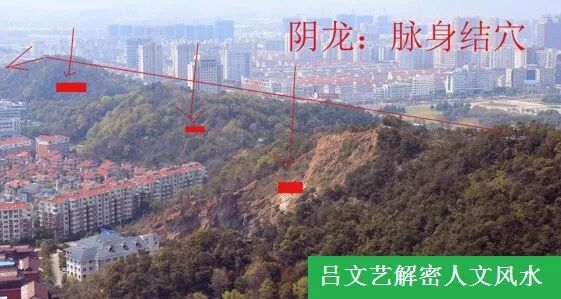
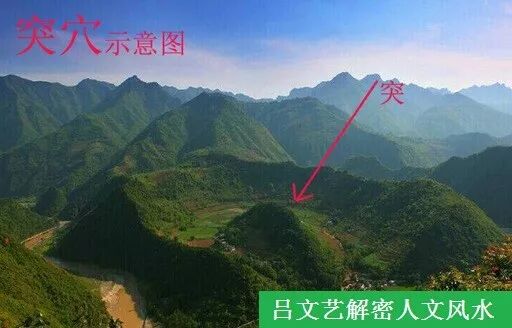
A yin dragon is one where the point is made on the body of the vein itself.
A yang dragon is one where a separate star-peak rises and the point is made there.
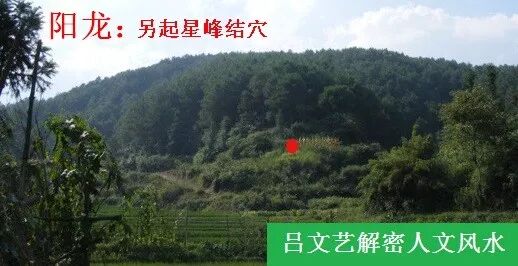
Why bother dividing them? Because point selection has to answer the question where on the xue field, exactly, does the point go — and if you do not know whether the dragon before you is yin or yang, you can make a fundamental error. Pure yin does not generate; pure yang does not grow. A yin dragon takes a yang point. A yang dragon takes a yin point.
The open face
Having settled yin and yang, where on the dragon's body do you place the point?
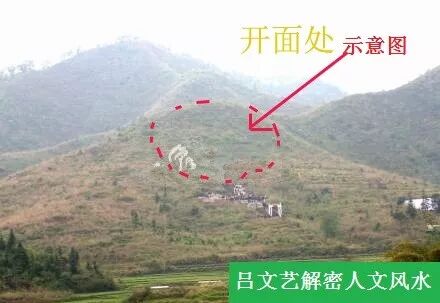
At the open face. Liao held that the point lies within the open face.
What is the open face? On the slope where the vein ends and knots, a patch of ground that is slightly concave or slightly flat — like the hollow of a palm.
The halo
Does an open face always contain a point? No. Liao held that you must then check whether the open face contains a taiji halo.
What is the taiji halo?
Stand on the desk mountain or facing mountain opposite the point-star, and look at the open face of the point-star where the vein knots. If a round halo roughly resembling the taiji diagram is faintly visible there, that faintly visible ring is the taiji halo.
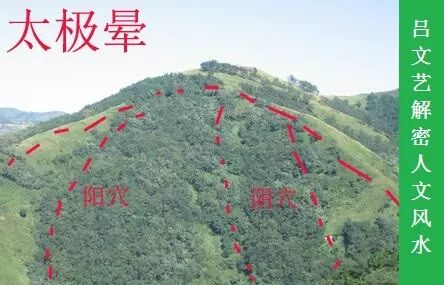
It has no fixed size. The large ones may be tens or a hundred metres in diameter; the small ones one or two metres.
Within the halo, the sunken places are yin points and the raised places are yang points.
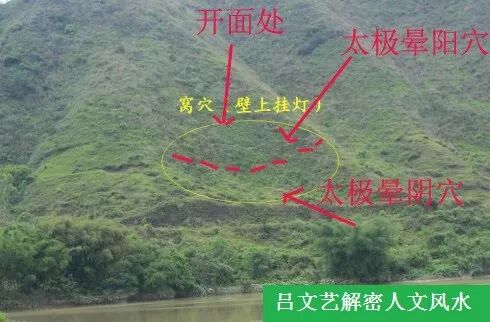
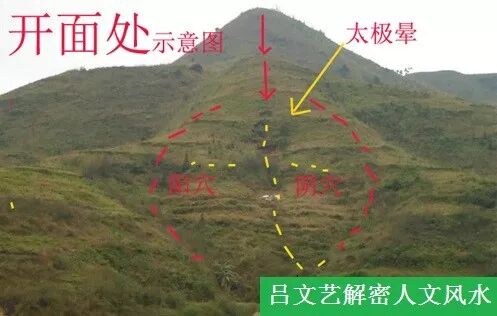
For a yin dragon, place the point at a raised yang position within the halo. For a yang dragon, place it at a sunken yin position.
Two ways a halo can form — and only one of them counts
A taiji halo can arise in two ways. One is from changes in landform and topography. The other is from differences in soil texture and soil colour.
These two have nothing to do with each other. In traditional feng shui, only the halo formed by landform is a true taiji halo.
The taiji halo is the sole criterion for whether a true dragon's body carries a true point. Without a halo, no matter how living or how true the dragon, every point on its body is a false point — what the tradition calls a “false flower point” (xuhua xue).
(A note from the author: because plagiarism is endemic in this field, and for the protection of his own work, much of the core content is taught only in person. He asks that readers not reproduce the material.)
The error that will not die
There is another situation entirely: you select a point, dig the pit, and find a taiji halo in the pit.
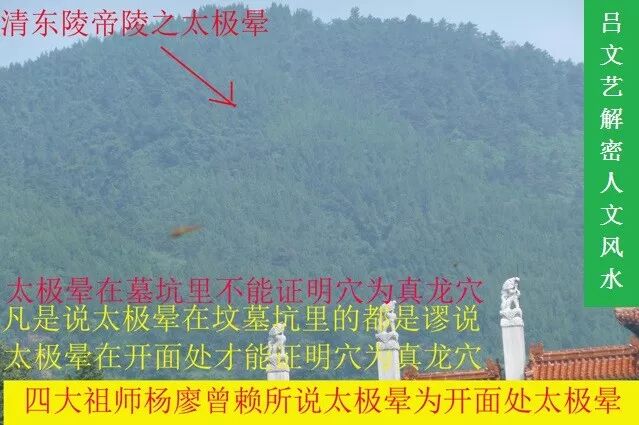
A halo in the pit cannot prove that the site is a true dragon point. And yet from the Republic to this day, everyone in the feng shui trade has treated the halo in the pit as the proof of a true dragon point.
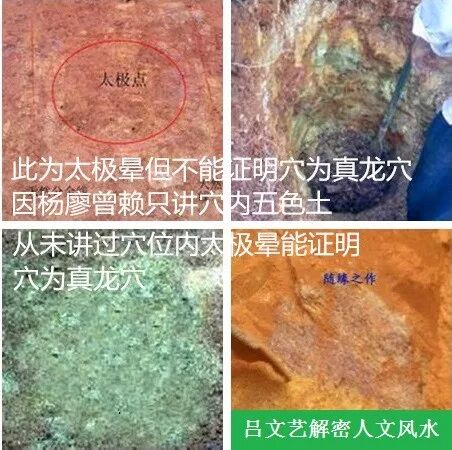
Yang, Liao, Zeng and Lai were not talking about a halo in a grave pit. Put it in plain words: the coffin is inside the taiji halo — the taiji halo is not inside the pit. We select the point within the halo; we do not select the point, dig the pit, and then look inside for a halo.
If those soil-layer changes in the pit were the taiji halo, then anywhere at all, using only four variables — soil moisture, soil colour, soil horizon and soil texture — and a little digging technique, anyone could produce a taiji halo 100% of the time.
The taiji halo of an imperial tomb: the Eastern Qing tombs.
Narrowing it down: vein, breath, hollow, mound
Suppose you now know that the point should be at a yin or yang position within the halo. Where within that yin or yang position does it go?
Working within that faintly visible landform, Liao identified four topographic features inside the yin or yang position: vein (mai), breath (xi), hollow (ku), mound (tu). They are not the same, and the coffin must be placed according to which one you have — which specific spot within the yin or yang position it should occupy.
That is why the Sixteen Burial Methods is the only genuinely precise method of point selection.
Vein (mai): very slightly raised, small in volume, elongated, and looking weak and limp.
Breath (xi): higher, looking strong and forceful, with an irregular base.
Hollow (ku): in plain words, a pit. Pits vary in size and depth; ku is the more accurate term for both regular and irregular ones.
Mound (tu): round in character, a raised half-dome of ground with a circular base.
Breath and mound are somewhat similar. Geometrically the difference is this: the base of xi is irregular, whereas tu is shaped like half a ping-pong ball with a circular base.
Vein, breath and mound are related and hard to tell apart. By volume, xi is the smallest. By shape, tu is the most perfect and xi the most irregular.
Source:WeChat public account “Shikongren Coordinates” (时空坐标) · by Lü Wenyi
Chinese original:传统风水学之“阴龙、阳龙、开面处、太极晕”实地照片详解
Notice:This is a study archive. Copyright remains with the author. Nothing here constitutes advice.