Are the Ming Tombs a Good Feng Shui Site?
Translator's note. The case study that the whole practice layer has been building toward. Thirteen imperial tombs, chosen by the best geomancers the Ming court could hire, in a valley that satisfies every classical criterion — and eight emperors born after the tombs were made, none of whom reached forty. Lü's explanation is the vein-qi stratum: the points were set at the edge of the qi-bearing layer, or on it but not at its most concentrated spot. The three pre-emptive rebuttals in the middle — you cannot say the imperial geomancers were incompetent, or disloyal — are the strongest part of the argument, because they close the escape routes.
The Ming tombs outside Beijing are the “dragon points” of thirteen Ming emperors. And yet not one of the eight Ming emperors born after those imperial tombs existed lived past forty. The Chongzhen emperor, born after the Zhaoling tomb of the Longqing emperor was made, not only lost the dynasty but died at thirty-five. Before him, the Tianqi emperor, Zhu Youxiao, lived only twenty-three years. And the other eight of the sixteen Ming emperors who did live past forty were all born before the tombs outside Beijing existed.
A person's fate is decided by the feng shui of the ancestral graves before his birth, and by the feng shui of the house where his mother spent most of the ten months of pregnancy. Changes to the ancestral graves after his birth, and the feng shui of the houses he later lives and works in, cause only a fluctuation within the quality tier that the pre-natal grave and dwelling fixed for him.
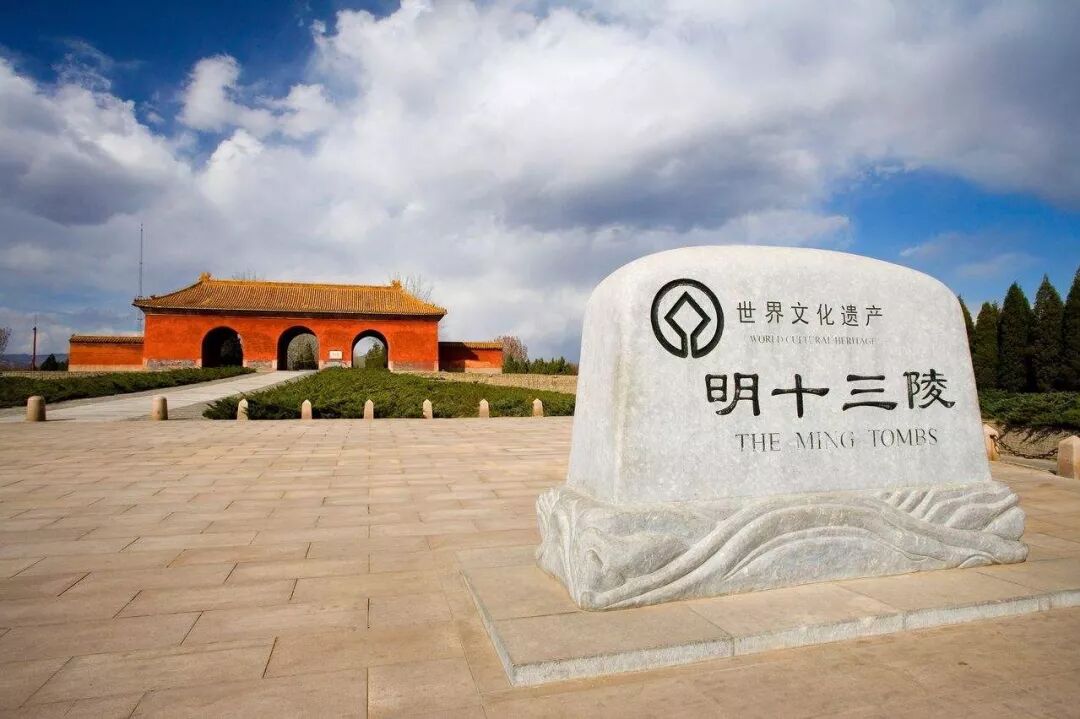
Eight emperors born after the dragon points of the Ming tombs existed died young, and the dynasty fell. What does that show? That the Ming tombs are not a treasure site? The answer is: they are not.
If you have walked the tombs of each of those emperors, you will find that the dragon of the Ming tombs comes from far away, its vein energy is enormous, the hills surround and the water embraces, the sand and water are affectionate — it really is a treasure site. So why did a treasure site produce eight short-lived emperors?
If you understand two things — which stratum of the dragon the vein's qi is stored in, and how that energy gathers — you will see it. None of the thirteen imperial tomb points was set in the stratum where the vein's qi lies, at the position where the energy is most concentrated and can be most fully used. The points were set at the edge of the vein's qi; or, where a point did sit on the qi-bearing stratum, it was not at the most concentrated spot on it. So although their descendants became Sons of Heaven, they received no inexhaustible supply of vein energy, and one after another died young.
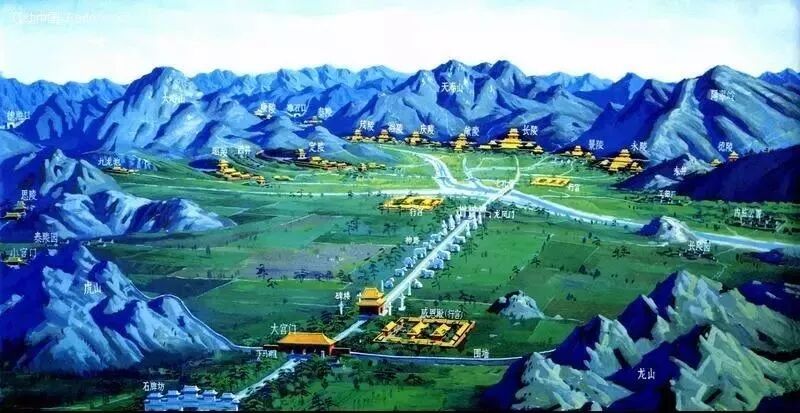
Map of the Ming tombs.
The Zhaoling of the Longqing emperor and the Qingling of the Taichang emperor were set even further off: upstream of the stratum from which the qi pours away. The consequence was that the Chongzhen emperor, Zhu Youjian, born afterwards, drew little energy from the Zhaoling which fixed his pre-natal fate, and could get no post-natal replenishment from the Qingling of his father, the Taichang emperor. With no energy of fate left to draw on, he lost the dynasty and took his own life.
The essence of feng shui is using the vein energy of the dragon. Where that energy lies is decided by the structure of the dragon's strata — not by the dragon's outward shape, nor by hills around and water embracing. The shape and the embrace are the surface of feng shui, not its substance.
I have surveyed every imperial tomb in China that can be surveyed, dynasty after dynasty. With the theory of strata structure and the accumulation of energy in strata, the great events that befell the later emperors of each dynasty can be explained completely, in feng shui terms. With the traditional theory of the treasure site, and with liqi, they cannot be explained at all.
Someone may say I do not understand liqi, and therefore cannot explain it. I am willing to concede that. But the emperors of successive dynasties, burying their predecessors, would hardly have hired a man who did not understand liqi — would hardly have hired a geomancer inferior to you. If you dismiss every liqi master the imperial courts employed, and hold that none of them understood liqi as you do, then I have nothing more to say.
Someone may say I do not understand the form-school theory of the treasure site, and therefore cannot explain it. I concede that too. But I cannot work out this: did the imperial form masters not understand the form-school theory of the treasure site? If they did, how did they come to set points that were short-lived and lost dynasties? And if you say they did not understand it and only you do, then again I have nothing to say.
And if you say the imperial geomancers deliberately set the wrong points and the wrong liqi — then let me ask: the imperial geomancers were a team, not one man. Was there not a single one in the whole team loyal to the emperor? Was the emperor so incompetent as to staff his site selection entirely with enemies?
Which shows plainly: the essence of feng shui lies inside the dragon, not outside it. For if the essence lay outside, the geomancers employed by every dynasty would not have set points that left later emperors short-lived or cost them the throne — since it is impossible that the imperial geomancers did not know the form school and the liqi school, impossible that they were inferior to today's masters, who cannot even read the old books, let alone translate them.
The reason the imperial geomancers set wrong points is entirely that they saw the dragon's outward shape and not its internal structure. Every geomancer in every age has inferred where the vein's qi lies by observing and analysing the dragon's external features — finding the true dragon point by reasoning from outside to inside — and error was therefore unavoidable. Find the location of the vein's qi directly, from the internal structure of the dragon, and the thing becomes as easy as turning over a hand.
Every dragon has a true dragon point, but their energies differ. Only a point with more energy than every provincial-and-ministerial-level point in the country will produce imperial rank; only a point with more energy than every geomancer-level point in the country will produce provincial-and-ministerial rank. But any true dragon point at all is more auspicious than an ordinary point.
Friends who want to understand the real technique of seeking the dragon and setting the point may read the relevant essays on my Sina blog; and by walking the imperial tombs of the Ming for themselves, they will understand what a true dragon point actually is.
Source:WeChat public account “Shikongren Coordinates” (时空坐标) · by Lü Wenyi
Chinese original:“北京十三陵”是风水宝地吗?
Notice:This is a study archive. Copyright remains with the author. Nothing here constitutes advice.