What Is a True “Dragon Point”?
Translator's note. The most important distinction in the practice layer, stated for the first time in 2017: there are two kinds of point, and only one of them deserves the name. The maiqi xue (脉气穴, the vein-qi point) sits on the stratum that carries the vein's energy upstream; the jiaodian xue (焦点穴, the focal point) is merely a place where surrounding sand and water reflect or trap a little stray energy. Everything the traditional trade calls feng shui — the embrace of hills, the orientation, the fenjin, the date — is, on this account, a description of focal points. The essay ends with the test cases that the traditional theory cannot answer: the Ming tombs, and the Eastern Qing tombs.
What is a dragon? A dragon is a mountain range, or a water course.
What is a dragon point? A dragon point is that position — that point — within a mountain range or water course (the water course seen on the surface, the strata seen in substance) where the vein energy is greatest and most concentrated.
What is a true dragon point? A true dragon point is one of those points where the vein energy accumulating in a mountain range (or water course) is at its greatest and most abundant, and can be used by us most effectively. Because mountain ranges differ in length, height, width and internal structure — or, for water courses, in length, width, depth and flow pattern (this is the surface phenomenon, and it belongs to the focal point; only the strata can locate the vein-qi point) — the vein energy of different true dragon points varies. The greater the energy, the greater the wealth and rank that follow. But however great or small, any true dragon point guarantees at least an upper-middle level of prosperity.
Traditional feng shui holds that a true dragon point on a dragon come a thousand li is more prosperous than one on a dragon come a hundred li, and a hundred li more than ten. In fact, even if the dragon has come a thousand li, if the stratum carrying the vein's energy upstream of the point is broken or destroyed, the point's energy may well be less than that of a point on a dragon come a single li.
Scientifically and objectively, the prosperity of a true dragon point is not determined by the length of the dragon. It is determined by three things: the distance, upstream from the point, over which the qi-bearing stratum continues unbroken; the number of undulations within that unbroken stretch; and the thickness of the qi stratum itself together with its density relation to the strata above and below it. It is emphatically not determined by the surface length of the range, nor by whether the sand and water embrace the site affectionately. Between a true dragon point and a fond embrace of sand and water there is, one might say, no substantive relation at all. Whether the sand and water embrace the point affects it only at the surface level.
A true dragon point is like the mouth of a spring. As long as there is an inexhaustible flow of water underground feeding it — and the vein-qi stratum of a true dragon point is exactly the spring's source — then no matter whether the mouth of the spring is embraced by sand and water, you can put your lips to it and drink sweet water forever. Put your lips instead at the mouth of a spring with no inexhaustible source, and however wide your mouth, however well you wrap it around the opening, you will never drink sweet water forever. As long as water keeps gushing out, eight winds blowing do not stop you drinking; they only cost you some of the energy. But if no water comes out, no wind at all makes any difference.
So a true dragon point always has an inexhaustible supply of vein energy for us to use, and whether it is ringed by hills and embraced by water matters very little. Of course, a true dragon point with hills around it and water embracing it is a beautiful woman in beautiful clothes. But a beautiful woman in rags, or with no clothes at all, is still absolutely a beautiful woman. The relation between a true dragon point and its sand and water is the relation between a beautiful woman and beautiful clothes.
Understand this and you understand why every single imperial tomb in the Ming tombs outside Beijing perfectly satisfies the feng shui rule of “hills around, water embracing, sand and water affectionate,” and yet produced idiot emperors, short-lived rulers, and the emperors who lost the dynasty. You understand why every tomb in the Eastern Qing tombs perfectly satisfies the traditional theory of the “true dragon point,” and yet produced only one wise ruler, the Qianlong emperor, while the other wise rulers were all born at the Western Qing tombs. The “qi-bearing stratum” theory completely explains why the descendants of each individual imperial tomb differ. The “hills around, water embracing” theory cannot explain these facts at all. With our theory of the true dragon point, the actual record of each tomb's descendants can be explained cleanly and completely.

At this point some master will say: Lü Wenyi, if you claim that most of the imperial tombs at the Ming tombs and the Eastern Qing tombs are not true dragon points, why did the Ming and Qing dynasties each last two or three hundred years? A good question, and a sharp one. But in fact it is not really a question at all, because everything in the world follows laws of development and change — the law of inertia and the law of energy. A dynasty is founded because it obtained enormous energy; that energy is spent, and a dynasty dies only when two conditions are met at once: its own energy is nearly exhausted, and another enormous energy has already come into being. Take a train already running at speed. To stop it you need a counter-force greater than its momentum — a hillside, a ravine, the brakes slammed on. How long it takes to stop is decided by the contest between the momentum of the train and the counter-energy opposing it. A dynasty rises because its founding ancestors obtained enormous energy; it falls because another, greater energy appeared and in the end consumed the energy of the previous dynasty. But producing that outcome takes time. That is to say, the fall of a dynasty cannot defy the law of inertia either.
Physics tells us that a body in motion, with zero resistance, will move forever; the smaller the resistance, the longer it moves. And if a moving body meets great resistance but at the same time is continuously supplied with great added force, it will also move indefinitely — and accelerate, if the added force exceeds the resistance; or move for a very long time, if the added force is slightly less; or stop very quickly, if the added force is much less. People and dynasties are alike. All motion is the product of energy: receive energy and you keep moving; receive none, and you stop when you meet resistance.
Understand this, and you should understand the significance of the true dragon point — and why most of the imperial tombs at the Ming tombs and the Eastern Qing tombs are not true dragon points. If a dynasty can continuously obtain enormous energy, then even when a great counter-energy has appeared, it will last a very long time. If it cannot — or obtains it only intermittently — then once the great counter-energy appears, it will die quickly. Understand this, and the two or three hundred years of the Ming and the Qing, and the brevity of the Qin, all become intelligible.
When I say that the true dragon point is decided not by hills around and water embracing but by the structure of the stratum in which the vein's qi lies — and for the flat plains too, the true dragon point is decided by the stratum — many masters who read dead books and read them to death will try every kind of smear against me online, to defend the theory that a true dragon point is decided by the embrace of sand and water: a theory that cannot survive either practice or theoretical derivation.
Why do I say so? Because these masters do not know that the configuration of hills around and water embracing is at most the focal point — the smallest-energy kind of point there is — and not the vein-qi point formed by the stratum where the vein's qi lies. Because they do not know that only a vein-qi point has an inexhaustible supply of vein energy for our use, while a focal point holds only a pitiful little focus of energy reflected off the surrounding sand and water and leaking from the strata. Because they do not know that what determines the quality of a person's fate is form (luantou), not liqi — even though they are forever quoting the line “form is the body, liqi is the clothing.” When there is money and reputation to be had, they treat liqi as the body and form as the clothing.
And because these masters do not know the fundamental difference between the vein-qi point and the focal point, they study and propagate liqi — orientation, fenjin, the date and hour — as the root of feng shui. Since the focal point is itself formed by energy reflected from the surrounding sand and water, the size of its energy does bear some relation to orientation, fenjin and date; those factors do influence, to a degree, the auspicious or inauspicious energy of a focal point. That is why orientation, fenjin and date selection have a little accuracy when applied to focal points. But analysed to the bottom, even a focal point's auspicious or inauspicious energy is decided not by orientation, fenjin and date, but by the shapes and sizes of the surrounding sand and water that form the focal point. Orientation and date at most cause a small fluctuation in the energy at that spot.
If friends everywhere can understand this, they will never again fall into the feng shui traps that the clever swindlers of this trade have designed so carefully.
From this article I think readers should be able to see: dragon points come in two kinds, the vein-qi point and the focal point. Only the vein-qi point can be called a true dragon point; the focal point cannot. The vein-qi point is the dragon point of greatest energy; the focal point is the dragon point of least. A vein-qi point guarantees at least upper-middle prosperity; a focal point guarantees at most the prosperity of a geomancer — which is to say, generally a little above average. A vein-qi point is that spot in the stratum where the vein's qi lies, where the supply is inexhaustible, most concentrated, greatest, and most effectively usable by us. A focal point is only a spot formed where sand and water reflect, gather or block energy; its energy is far less than a vein-qi point's. Sometimes the two coincide; when a vein-qi point and a focal point fall on the same spot, the good fortune is doubled. Focal points are easy to find, and vein-qi points are even easier — the key is that you must understand where in the dragon the vein's qi lies. Once you have located the stratum in the dragon that carries the qi, the vein-qi point is easy to find.
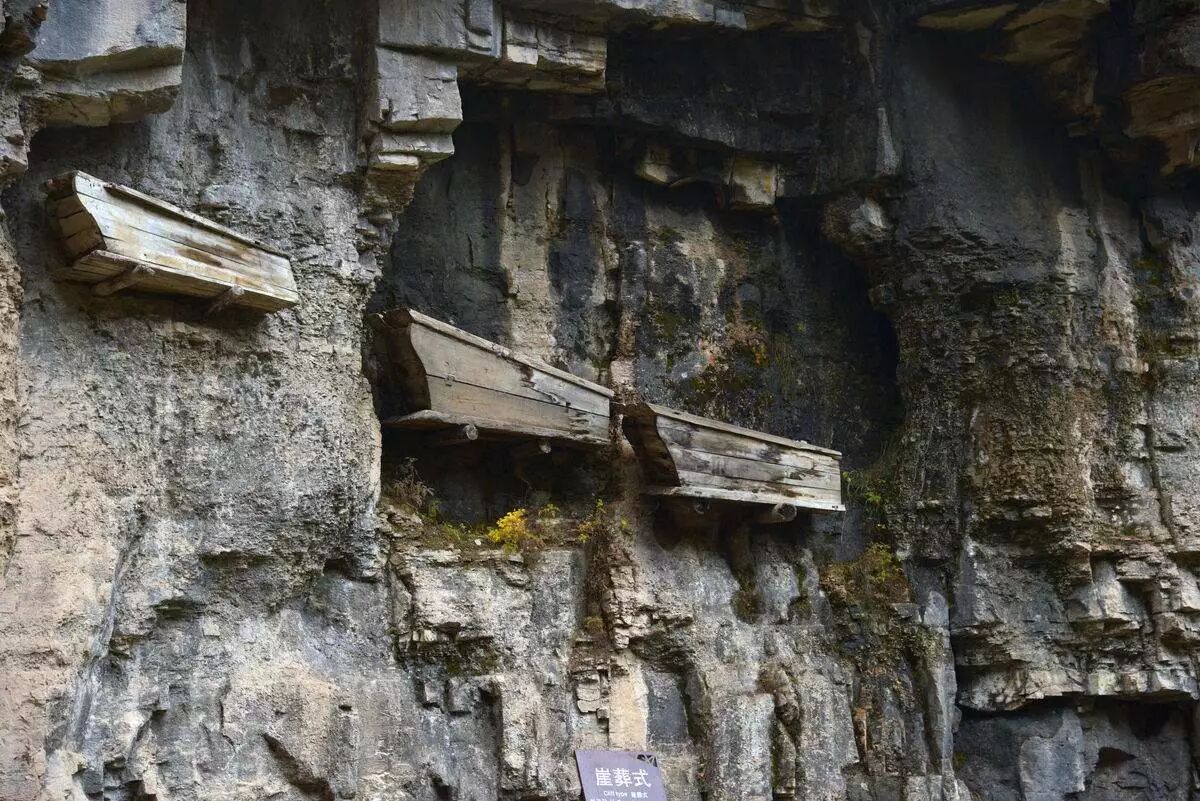
Once the vein-qi point is understood, a whole set of ancient puzzles solves itself. A coffin placed on a cliff face can still produce generals and ministers, great wealth and high rank — because the coffin happened to sit on the qi-bearing stratum. A man living in a cave in a cliff can still produce the same — because he happens to live on the stratum. A man living, or a coffin buried, in flat country with no sand, no water, no river and no hill, can still produce emperors and ministers — because the spot is exactly where the vein's qi breaks out of the ground. A place where the sand flies, the water runs away, where sand and water turn their backs and shoot at the site, can still produce great wealth and rank — because although the sand flies and the water runs, the point sits precisely on the qi stratum. And a place with hills around and water embracing, affectionate in every particular, can produce not prosperity but poverty, meanness and early death.
Understand the fundamental difference between the vein-qi point and the focal point, and in actual fieldwork you will not be blinded by the partial theory of “hills around, water embracing” and misjudge a site. (Mao Zedong's birthplace, in fact, has a bright hall of reversed-bow water, with sand flying and water running to the northeast, north and northwest.) You will be able to choose a genuine vein-qi point, a site that produces generals and ministers, great wealth and rank. You will be able to use the inexhaustible energy of the vein-qi point to change fate, for yourself and for others, to a very large degree: poverty and meanness into the ordinary, the ordinary into small prosperity, small prosperity into middling, middling into great. Using a vein-qi point raises a person's level of fate by one or two grades. Only those born after the point came into use can be emperors or ministers; for those already born before the true dragon point was used, the most that can be done is to raise them one or two grades. A focal point can also change a person's fate — its energy is smaller and the change is smaller, but it is still a thousand times better than a spot that is not even a focal point. For a spot that is not even a focal point produces, at best, a very ordinary person.
A true dragon point holds auspicious energy and dangerous energy both. Only when your birth order and birth time align with the direction from which the vein-qi point's auspicious energy comes do you have good fortune to speak of. If your birth order and birth time align with the direction of its dangerous energy, you will have great calamity. And if neither — if your birth order and birth time match neither the auspicious nor the dangerous direction — then that vein-qi point has only the effect of sand-and-water fortune on you, and no vein-energy effect at all.
The vein-qi point is the true dragon point.
The focal point is not.
Source:WeChat public account “Shikongren Coordinates” (时空坐标) · by Lü Wenyi
Chinese original:什么是真正的“真龙穴”?
Notice:This is a study archive. Copyright remains with the author. Nothing here constitutes advice.