The Dragon Vein: Passing the Canopy, Crossing the Gorge, Binding the Breath
Translator's note. A short technical note, and the clearest statement in the collection of what chuanzhang, guoxia and shuqi actually refer to — three names, the author insists, for one place: the narrow saddle where two summits are joined by a ridge. The essay is worth reading for the last two paragraphs alone, which argue that importing the feudal hierarchy of ruler and minister, father and son into a natural science is a category error. “Whether there is oil underground has nothing to do with the social system.”
A dragon vein runs from the ancestral mountain to the parent mountain to the point-star. Where the vein stops is the dragon's head; where it begins is the tail. Low ground is the head, high ground the tail. “Head” and “tail” here do not describe the animal's shape. They describe where the vein's qi comes to rest. Traditional feng shui holds that the vein's qi travels inside the ridge, from high ground toward low, and so the place where the qi runs out is called the head.
Looked at as a whole, the vein rises and falls, and the long narrow join between two summits is where it passes the canopy, crosses the gorge, and binds its breath. In substance these three terms mean one and the same place. (See the figure.)
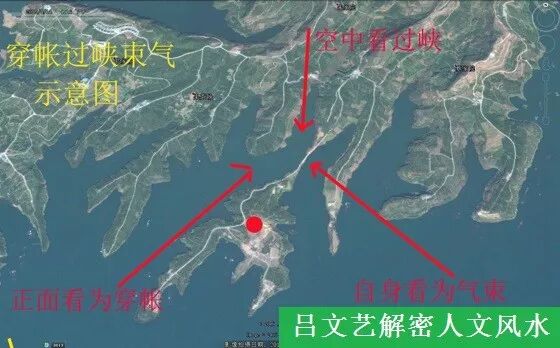
Shu means something drawn together into a single strand. Seen from the vein itself, the vein goes from thick to thin and back to thick; at the thin place the qi is drawn into one line, and that is why it is called “binding the breath.”
If you stand at the point-star where the vein ends and look back at the constriction, the qi appears to come out through the mountains on either side, like a man emerging from behind a hanging curtain. Hence, figuratively, “passing the canopy.”
If you look at the constriction from the air, the escorting mountains on either side form a gorge, and the vein's qi passes through the gorge. Hence “crossing the gorge.”
Traditional feng shui holds that if the constriction is broken, the passage through the canopy has failed and the dragon ahead of it is a dead dragon. For the crossing to succeed there must be escorting dragons on both sides. If there are no escorts to left and right, or if the constriction is cut through, the crossing has failed. (See the second figure.)
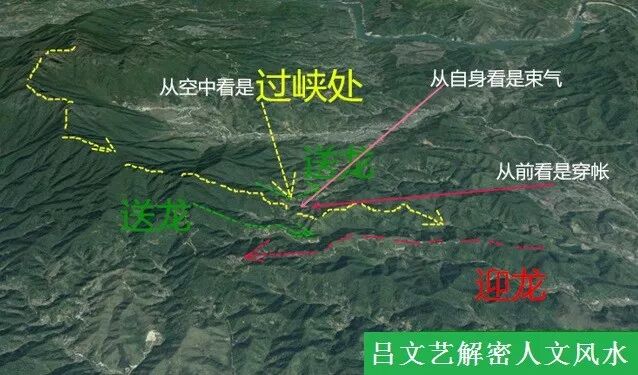
Strictly speaking, every dip between two summits is a gorge crossing. The vein's qi moves the way an emperor moves: it needs attendants before and behind, guards to left and right, or the emperor is both undignified and unsafe.
Traditional feng shui carried the human world's hierarchy — the three bonds and five constants, ruler and minister, father and son — straight into the subject. In fact the notions of human ethics and the theory of feng shui have nothing whatever to do with each other. Moral and humanistic ideas belong to the social sciences. To interpret a natural science through the humanities and social sciences is absurd in itself. Whether there is oil under the ground has no relation to the social system; natural disaster has no relation to human morality.
Source:WeChat public account “Shikongren Coordinates” (时空坐标) · by Lü Wenyi
Chinese original:传统风水学之龙脉的穿帐、过峡、束气
Notice:This is a study archive. Copyright remains with the author. Nothing here constitutes advice.