Is a Cut Dragon Vein Always Bad Luck?
Translator's note. This is the article that makes the theory testable. If the vein's qi lies in a particular stratum, then breaking that stratum should change a site's fortunes — and it does, in both directions. The four diagrams describe a site that produces nothing for five hundred years, then produces great wealth the moment a road is cut through the hill above it. Lü adds a rebuttal to the “period luck” school that is worth following closely, and quotes the Ming author Xie Heqing against it.
Every feng shui master, ancient or modern, Chinese or foreign, will answer without hesitation: a cut dragon vein is inauspicious. My answer is: a cut dragon vein is not necessarily inauspicious at all.
Why so absolute? Masters, do not lose your tempers. Let me explain.
What is a dragon vein? A mountain range or a water course. What is vein qi? The energy stored in that range or course. Where in the range does the vein qi lie? Yang, Liao, Zeng and Lai — the founding masters — never said clearly. Why not? Because in their time there was no theory of strata structure and the accumulation of energy in strata. They did not understand that oil has its stratum, gas its stratum, coal its stratum, iron its stratum, gold its stratum. They did not understand that energy is stored in particular layers. Naturally they did not know which layer of a dragon holds the qi that affects human fate. So they took the wholly conservative route to protecting the qi: do not dig the dragon. Cut the dragon and you cut the qi.
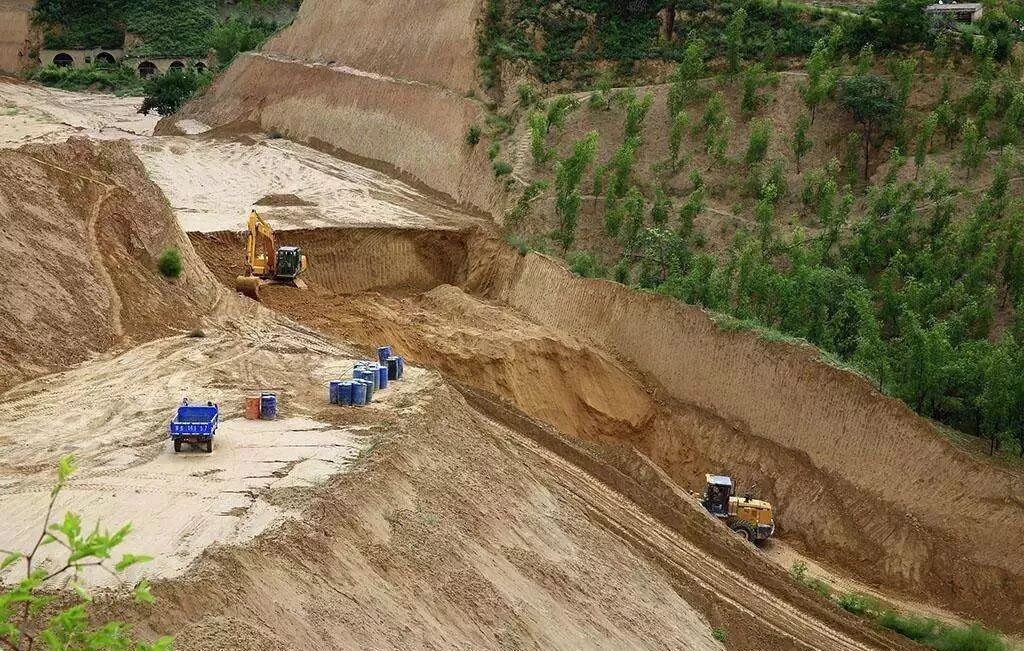
The objective fact is otherwise. There are very many ancestral graves and dwellings that for generations produced no great wealth, no high office, no ministers and generals — and then a road was run along the dragon, a hillside was quarried, a tunnel was bored, a bridge was built, a reservoir was dammed. Overnight those poor sites became sites of great wealth and high rank.
Why? The masters of liqi, who cannot distinguish principal from secondary, will explain it by “period luck” (qiyun). So let me put a question to them. A site has been in use for five hundred years. Why was there no period luck before, and only after 1990 was there any? Is the luck of the first seven-period different from the second, third and fourth? One yuan is a hundred and eighty years — is the luck of the first hundred and eighty years different from the second and the third? At this the swindlers will say: the luck is the same, but the people born are different. So I ask again: in five hundred years of use, with more than three thousand births, is there not one person with the same zodiac sign and the same life palace? There are dozens of pairs of twins — why do their fates diverge so widely?
Xie Heqing, author of the Shenbao Jing and a great Ming-dynasty figure in the field, wrote: “Form is the orthodox. To discuss fortune and misfortune by compass and hexagram is to glue down the pegs and carve the boat — a side road, fragmented and mistaken.” Which shows: any master who explains a feng shui question by period luck is simply a swindler who keeps finding fresh reasons to prove himself right.
I am not denying period luck. It has its own science and its own truth. But the study of period luck is emphatically not the core theory of feng shui. Period luck causes a slight fluctuation in vein qi. If there is no vein qi to use, the best period luck in the world will not produce a minister; if there is vein qi to use, the worst period luck will still produce one. Whether a site can produce great wealth and high rank is decided by vein qi, not by period luck.
With that understood, let us return to the question: why does cutting the dragon sometimes produce great fortune? The figures will make it easier.
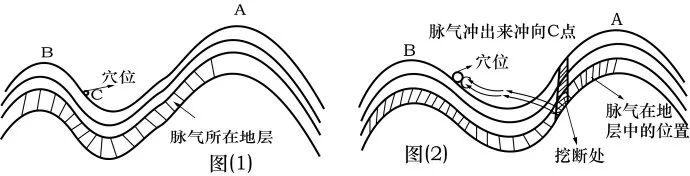
Figure 1. Before hill A is cut, the vein qi passes underground and has no connection with point C. Point C receives no energy.
Figure 2. After the stratum holding the qi is cut through, the vein qi pours out and runs down the slope of hill A straight at point C. Point C therefore receives the vein's qi — which is why the people at C became rich very quickly after the hill was cut. But when the excavation continues to the point where the terrain no longer lets the qi flow to C, C stops producing wealth.
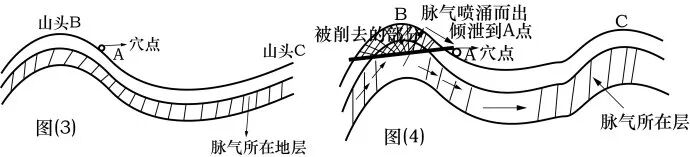
Figure 3. Here point A is far from the qi stratum and does not touch it. A receives nothing, and produces neither wealth nor rank.
Figure 4. When the summit B — the backing mountain behind point A — is levelled, the qi stratum in the vein is cut. Once cut, the inexhaustible qi gushes out of the strata and pours onto point A. A receives the vein's qi, and the people at A become wealthy, even to the level of ministers.
These two examples show how cutting a dragon can be auspicious. It does not follow that a dragon must be cut to be good. The point is this: whether a point can produce great wealth and high rank depends on whether the point receives the vein's inexhaustible qi. Whether the stratum has been cut or left intact is beside the point. What matters is whether the point lies in the stratum that holds the qi, or can come into contact with the qi inside that stratum. If it does not, it will never produce a minister. Only when the point sits exactly on the qi-bearing layer, or touches the qi within it, can it produce great wealth and high rank.
Yang, Liao, Zeng and Lai did not know the structure of strata and did not know which layer the vein qi occupies, or how it gathers and flows. Judging only by the visible form of the surface, they could not guarantee that the point they chose lay on the qi-bearing stratum or touched the qi. That is why those founding masters did not manage to change their own descendants' fates into great wealth and high office; their descendants ended up poor, and remained geomancers. (And even had they found a true dragon point, they had no precise notion of the magnitude of energy, so they still could not have guaranteed that their descendants would reach ministerial rank. The degree of prosperity is set by the amount of energy in the vein. If the vein holds little, even an accurate point will not produce ministers; it will guarantee some prosperity, no more.)
Understand this, and you understand why cutting the dragon sometimes enriches and why an intact dragon sometimes produces nothing. But readers should grasp a more important point as well. If the dragon is intact and the point happens to lie on the qi-bearing stratum, that is many times better than obtaining the qi by destroying the stratum. Getting at the qi by breaking the layer that holds it is, after all, killing the goose for the egg.
After reading this, friends should be clear on the following.
1. Because the strata of different dragons differ, the vein qi is stored in different layers.
2. Only if the vein's qi is in close contact with the chosen point can that point produce wealth, or rank, or a minister.
3. True dragon points are very numerous, but their energy varies enormously — and that variation is set by whether, and how badly, the qi-bearing stratum is damaged between the ancestral mountain and the point. The less damaged that stratum is, and the further its unbroken run reaches, the greater the prosperity. The more badly damaged, and the shorter the run, the smaller.
4. The more unusual the position of the qi-bearing stratum within the dragon, the greater its energy. Which layer the qi occupies is the core secret of seeking the dragon and setting the point.
5. Feng shui is a science, not a mysticism. It is objective and dialectical, not mechanical and dead. It is something we must keep developing and perfecting; the ancients did not reach the final truth. A master who does not study and research but only follows the old rules will decline with each generation. Only by using new science and new discovery to develop the subject can feng shui become a science, and benefit the practitioner, the client and society. Otherwise masters are only reheating the ancients' cold rice — cold rice with grit in it — and their descendants will end up carrying on the trade as poor geomancers, exactly as before.
Source:WeChat public account “Shikongren Coordinates” (时空坐标) · by Lü Wenyi
Chinese original:“龙脉”被挖断了就一定是不吉利吗?
Notice:This is a study archive. Copyright remains with the author. Nothing here constitutes advice.