Energy Channels in the Mountains
Translator's note. This is the mechanism that explains one of the oldest complaints about feng shui — why three graves in a row, sharing one view and one hillside, produce three entirely different families. The answer is not that the graves are different. It is that the energy arrives at a point, and only one of the three points is on the path. The umbrella analogy is the author's, and it is unusually good.
Two graves side by side. Twenty centimetres apart. One family prospers for three generations; the other produces clerks and misfortunes. The classical answer is that the sites differ. The answer here is that the sites are identical, and the arrival points differ.
How a ridge makes a channel
An energy channel is formed by relay.
Take three peaks descending in height, one behind the other. Qi of the chonghe kind — the balanced, harmonised qi that this system treats as the useful form — exists inside a mountain mass, but most of it arrives from space and settles on the surface. Once it lands, or once it spills out of a ridge, it does not spread evenly in all directions. It runs downhill, and it hands itself on.
The first peak discharges onto the second. The second receives that and discharges a larger quantity onto the third. The third discharges to the ground. What reaches the bottom is not a third of the total; it is the accumulated total, funnelled.
That funnel is the channel.
Why only one of three points receives anything
Place three origin points at the foot of the slope — call them A, B and C, in order along the direction the energy is running. Only B sits on the channel. A and C do not.
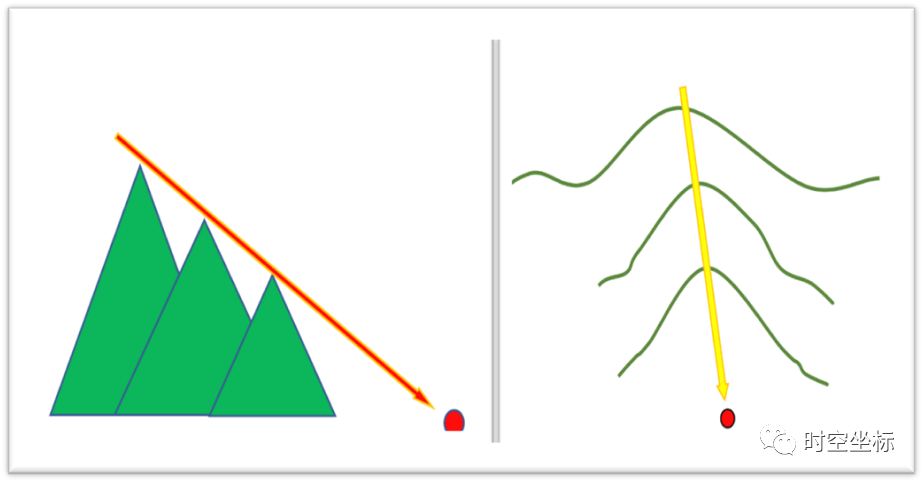
Three peaks descending; the relay runs down the line of the ridge.
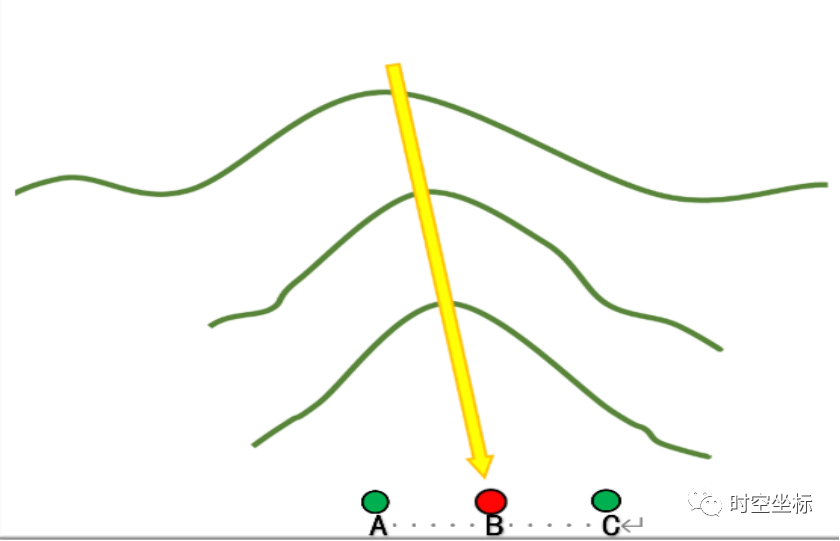
A, B and C are three origin points. Only B is on the channel.
If A, B and C are the graves of three brothers, twenty or thirty centimetres apart, facing the same eastern slope, the consequence is immediate. The eldest son of household B receives the whole eastern contribution. The eldest sons of A and C receive almost none of it — not because their sites are bad in some general sense, but because the energy is not landing where they are.
This is the ordinary explanation for the family plot that produces one wealthy branch and two unlucky ones. Three grandfathers are buried in a row; the second grandfather's descendants all do well; the first and third produce nothing but trouble. Practitioners who do not understand channels look at the three graves, see one identical eastern view, and have no way to distinguish them — so they tell the family that the difference is fate, or virtue, or the stars.
The relay, in umbrellas
If you have held an umbrella in the rain, you already have the model.
Open three umbrellas in a line, each lower than the one before, all tilted the same way. Rain falling on the highest runs off its edge onto the canopy of the middle one, which now carries its own rain plus what it received, and passes both down to the lowest. The lowest umbrella discharges everything — three canopies' worth — onto the ground at one point.
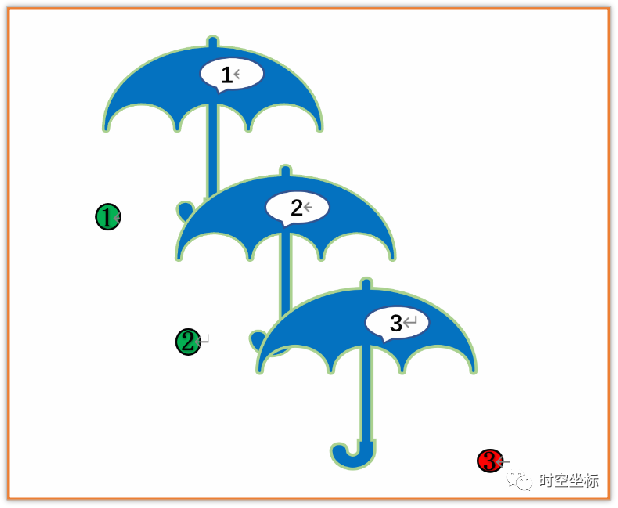
Three canopies in series; the third receives the accumulation of all three.
That is a channel. Not a metaphor for one — the same structure: a series of collectors at decreasing height, each passing its total to the next, discharging at the bottom.
What it is good for
Two practical uses.
Family plots. Once you can see the channel, the question of which branch prospers stops being a moral question and becomes a geometric one. Which grave is on the line? Which is thirty centimetres off it? The answer is visible.
Public cemeteries. This is where the method earns its keep. A modern cemetery is a grid of near-identical plots on a hillside, and practitioners who rely on the shape of individual graves are reduced to guessing, because the shapes are the same. But the channels are not the same. The rows cut across the slope at different heights; some plots sit on a relay line and some sit in the gaps between them. Two plots in the same row, six feet apart, can receive entirely different quantities.
That is also why the same cemetery can produce one prominent family and dozens of ordinary ones without anything being wrong with the cemetery. The site is not a single thing. It is a surface with paths across it, and most people are standing between the paths.
Source:WeChat public account “Shikongren Coordinates” (时空坐标) · by Lü Wenyi
Chinese original:山区的能量通道(一)
Notice:This is a study archive. Copyright remains with the author. Nothing here constitutes advice.