Reading a Public Cemetery
Translator's note. Public cemeteries are the hardest case in practice, because the rows of identical graves give the eye nothing to work with. The solution here is a rule about what to ignore: anything without individual character counts as flat ground, and only the conspicuously raised or sunken counts as sand or water. The second half is a genuinely unusual idea — that a cemetery's energy is a finite resource already partly consumed by earlier burials, which is why the article advises reading the neighbours' fortunes before buying a plot, and why it says the last family into a good spot gets nothing.
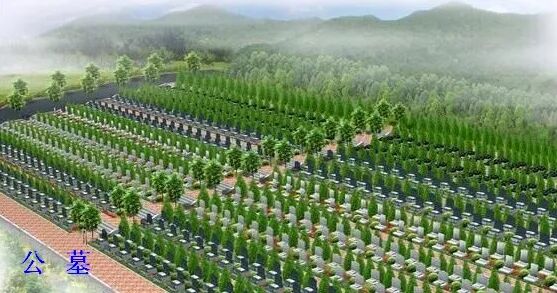
1. When surveying a public cemetery and setting a point in it, you face hundreds and thousands of graves laid out in ordered rows. Many masters walk in and have no idea how to begin, and cannot tell one grave from the one next to it.
The root cause is not only the margin of error in feng shui theory. It is also, and mainly, a failure of method. In fact, surveying and setting a point in a cemetery works exactly as it does anywhere else. The only difference is this: in a cemetery, treat every grave in front of, behind, left and right of your point that has the same configuration as your point as though it did not exist — as ground level. Anything conspicuously raised — a structure, a knoll, a grave — must be read as sand. Anything sunken — a pit, a small gully — must be read as water.
In a word: anything in a cemetery that is obviously special is sand or water; anything with no individual character and no particular energy is treated as absent. That is to say, taking the point as origin, if there is no special-energy object nearby, extend outward from the origin until you reach one, and only then read sand and water. Everything in the interval before that object counts as flat ground.
Once your thinking has turned this corner, reading a cemetery is exactly like reading a grave anywhere else. If your theory is correct, you will not misread and you will not set the point wrongly.
2. We know that the energy stored in any thing is fixed, not unlimited. Likewise the auspicious and inauspicious energy held by the sand and water of a cemetery is fixed, not unlimited. In a cemetery of fixed energy, the question of grabbing the feng shui becomes very important.
The reasoning is simple. Suppose a cave holds a hundred kilograms of gold and jewels, and a hundred people set out from their homes to fetch it. Assume no fighting and no snatching: whatever you get, you keep. Plainly, the first man into the cave carries out the most, and the last man in gets nothing.
By the same token, if there is a landmine ahead, the first man to step on it is the one who suffers; the men behind can step on the very same spot and nothing happens. There remains, of course, the question of whether you can find the cave, or step on the mine at all. Understand this, and you understand the significance of grabbing feng shui in a cemetery.
The principles are these.
1. In feng shui we call a mountain range (or a river) a dragon vein. Along a dragon there are many auspicious points, many dangerous ones, and a great many ordinary points that are neither greatly auspicious nor greatly dangerous. The purpose of setting a point is to draw on the energy stored in the dragon — and every thing has two sides, so the dragon's stored energy is partly auspicious and partly dangerous.
Set your point on an auspicious spot and you draw auspicious energy, and your descendants prosper. Set it on a dangerous spot and you draw dangerous energy, and your descendants end in poverty and without heirs. Set it on an ordinary spot, neither greatly auspicious nor greatly dangerous, and you draw neutral energy, and your descendants live ordinary lives as common people.
So to make the descendants prosper you must find an auspicious point on the dragon. In a cemetery, because so many are buried there, the auspicious points may long since have been taken. Even if one can still be found, you may well be the man who found the cave but walked in last, and you will come away with nothing. Which is to say: if you want your descendants to prosper greatly, you had better not choose a public cemetery.
But then again, if you only want peace and security for your descendants, then in a cemetery you need only avoid the dangerous points. And if you are not the first family into the cemetery — if eighty per cent of it is already occupied — then even burying your ancestor on a dangerous point will not bring any very great disaster, because most of the dangerous energy has already been drawn off by others. Bury on the very worst point, however, and disaster will still come.
2. If you do find an auspicious point in a cemetery, the best thing is to investigate the families buried within three metres in every direction. What matters is how those families have fared since they buried their ancestors there. If they have prospered since the burial, and the burial is some years old — five years or more — or they have had children since, then the auspicious energy there has largely been drawn off, and you should choose again.
When choosing again, look first downstream of those graves. Because qi flows from high to low, there is quite likely still a good deal of energy below, and a point set downstream will be comparatively auspicious. Whether there is energy downstream depends on the course of the dragon. Generally, if the qi flows deep inside the mountain, there will be a good deal of energy downstream. If it flows near the surface, the energy downstream will be very small or gone — and in that case you can still intercept some residual qi upstream.
Everywhere in the country you see “following the feng shui.” When one family becomes greatly wealthy and honoured, many others bury their ancestors in front of and behind that family's grave, thinking to grab some of the good feng shui. In fact, not one household in a hundred gets what it hoped for.
3. Having found an auspicious point in a cemetery, first write down in a notebook every auspicious sand and water feature in the eight palaces and twenty-four mountains, both in the large pattern and the small. Then use the theory of birth-order positioning to determine whose prosperity those auspicious directions decide — which birth order, in which generation. Having established that, go and investigate the families buried within three metres: since their burial, has a child of that birth order in that generation been born, or has a person of that birth order in that generation already risen in office or made money?
If neither has happened, bury your ancestor quickly. After the burial, if you yourself are that person of that birth order in that generation, and you catch the auspicious conditions of the timing system, you will prosper on schedule. If your family bears such a child, that child will grab the greater part of the auspicious sand-and-water energy and become wealthy and honoured in future. By the same token, at a dangerous point it is that person of that birth order in that generation who will suffer great calamity.
4. All of the above is the geographical system of Lü-school feng shui. Beyond it you must master the timing system as well, because only so can you grasp how the strength of the energy rises and falls, and so choose the burial date or the moment for adjustment correctly — and only then will the auspicious energy of the site arrive on schedule, bringing office, wealth, children and the removal of calamity.
Source:WeChat public account “Shikongren Coordinates” (时空坐标) · by Lü Wenyi
Chinese original:公墓的风水断法
Notice:This is a study archive. Copyright remains with the author. Nothing here constitutes advice.