Reading Feng Shui in an Apartment Block
Translator's note. The most directly useful article in the practice layer for a reader outside China, because it is about flats. The method is a cascade: choose the district, then the compound, then the building, then the unit, then the floor plan, then the room — and at every level compare the largest energy sources, not the nearest ones. Two warnings recur: the best-view building is not the best-feng-shui building, and the cheapest flat in a compound is sometimes the best one. The closing passage on why a badly-sited household can still get rich — the bad energy has to go somewhere, and it goes into the marriage or the body — is the most interesting claim in the piece.
There are two sides to feng shui in city apartment blocks.
First, how to choose a building.
Second, how to read a building's fortune.
Choosing and reading are inverse operations. When you choose, you hold the compass and look at which building is good and which is not. When you read, you put the compass down and look at whether this building is good.
What follows approaches the question from the side of choosing.
First principle: choose from the large to the small.
“Large” means the district: whether to choose in the eastern part of the city or the western, the southern or the northern.
Second: having settled the district, settle the compound within it; then the building within the compound; then which entrance or stairwell of that building; then which floor plan; then, facing several rooms, which is suitable as the master bedroom, which as a study for the child, which as a guest room, which as storage. Finally, when furnishing, mind the placement of the sand-and-water objects — the television, the computer, the fish tank.
At every level — compound, building, entrance, flat — the reference standard is the largest-energy object in the surroundings. Great energy means great consequence in fortune. So when choosing a building, an entrance or a flat, watch the largest-energy objects outside the compound: a natural hill, a river, a lake. And watch the large artificial features inside the compound: a rockery, an outdoor pool, a water feature. Do not fix your eyes on where the compound's main gate is. Do not fix them on where the drains — the water mouth — run off. The Sanhe school is obsessed with incoming and outgoing water; choose your site that way and you are asking for trouble.
The examples below make the method concrete.
Inside a compound, to judge whether a building is good, do not stare at the roads. Stare at the largest-energy object.
Example 1.
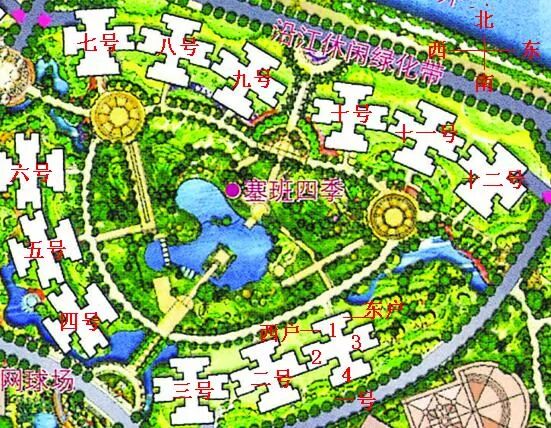
Step one: the largest-energy feature in this compound is the artificial water system in the middle, with twelve buildings around it. Water is auspicious in the northeast, northwest, south and west; inauspicious in the north, east, southeast and southwest. So the building that gets the most auspicious water gets the most good, and the one that gets the most inauspicious water gets the most harm.
Building 1: water to the northwest — auspicious. Building 2: water to the north and northwest — half and half. Building 3: water to the north — inauspicious. Building 4: water to the northeast — auspicious. Building 5: water to the east — inauspicious. Building 6: water to the east and southeast — inauspicious. Building 7: water to the southeast — inauspicious. Building 8: water to the southeast — inauspicious. Building 9: water due south — auspicious. Building 10: water to the southwest — inauspicious. Building 11: water to the southwest — inauspicious. Building 12: water to the southwest — inauspicious.
The candidates are therefore buildings 1, 4 and 9.
Which of the three is best depends on what you need, because auspicious water in the northeast, the northwest and the south does different things. Auspicious water in the south, at bing, wu and ding, bears more on the development of a career: if you are seeking office, building 9. Auspicious water in the northeast, at chou, gen and yin, bears more on money: if you want income to flow in from every direction, building 4. Auspicious water in the northwest bears more on achievement in cultural and academic life: if you want your child to get into a good university, building 1.
But water alone is not the whole picture; you must also look at what other large-energy sand and water objects stand around the three.
Building 4 has water to both east and west — water in opposite palaces, which is inauspicious.
Building 1 has flat ground to east and south, which counts as zero; auspicious sand to the southwest; auspicious water to west and northwest; a little water to the north, slightly inauspicious; auspicious water to the northeast.
Building 9 has auspicious water to the south; east and west form a balanced system; northeast, north and northwest are zero.
Comparing the three: building 1 is best, with the greatest auspicious energy; building 9 is next; building 4 is the weakest.
And do not assume that the compound's “king building” — the one everybody wants — has good feng shui. The king building has the best view. A good view is not good feng shui.
Step two: having chosen building 1, it has four stairwells, and their feng shui differs considerably. Which is best is again decided by the eight directions.
Entrance 1: auspicious water to the west and northwest. Entrance 2: auspicious water to the northwest; the west is balanced, zero. Entrance 3: west and northwest both balanced, zero. Entrance 4: the west is effectively sand; the ground plane to the east is zero; the northwest water has no effect on it.
Comparing the four, the best feng shui in this building belongs to entrance 1.
Step three: entrance 1 has two flats, and again there is a question of which is better.
The eastern flat has water due north; the western flat does not. Comparing the two, the western flat's feng shui is better.
Choosing a site is a process of comparing energies. If the compound is small and has no water feature or rockery inside, and the main gate is visible, you may treat the main gate as water when choosing a building.
Example 2. Compare buildings A, B and C.
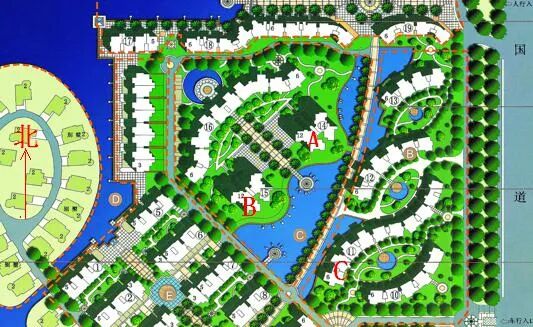
Building A: to the south, the compound's largest auspicious water; to the northeast, also auspicious water; elsewhere level.
Building B: to the southeast and east, large inauspicious water. The northeast has auspicious water, but the eastern water draws it over and converts it into inauspicious water. Elsewhere level.
Building C: auspicious water to the west and northwest, but the whole northern sector is inauspicious water.
Comparing the three, building A has the best feng shui.
Note: where a neighbouring palace converts a feature, the smaller the energy of the converted object, the more completely it is converted.
Example 3.
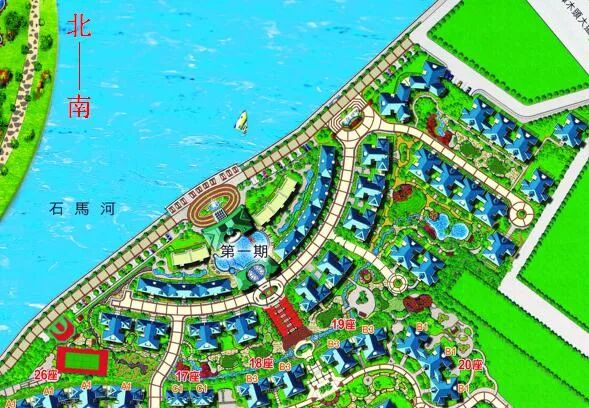
In a compound laid out like this it is hard to find an ideal site. Comparatively, the southeast part is better, because the west and northwest carry auspicious water.
Note: the cheapest flat in a compound may be the one with the best feng shui. The expensive part of a compound does not necessarily have good feng shui. Feng shui and scenery are two different concepts and must not be confused.
Example 4. How to choose a bedroom within a flat.
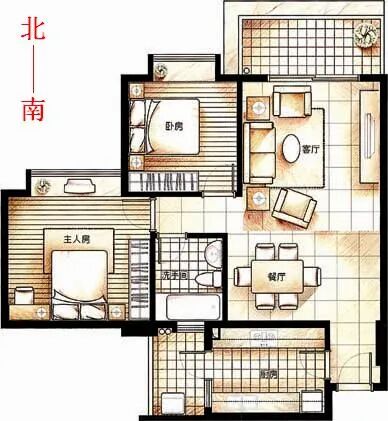
The master bedroom has a large bathroom to its east — inauspicious. It has a television to the north — slightly auspicious.
The second bedroom has a large bathroom to its south — auspicious. To its east is the living room, and the living room has a television — auspicious.
Comparing the two, the second bedroom's feng shui is better than the master bedroom's. It is better to sleep in the second bedroom over the long term.
Note: do not assume that a bedroom with an en-suite is better because it is convenient. Convenience is not feng shui. A view is not feng shui either.
Example 5. Another standard for choosing a bedroom.
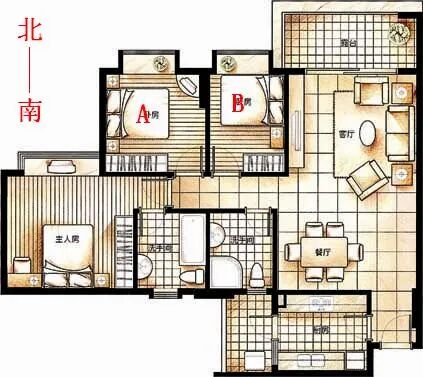
The master bedroom has two bathrooms side by side to its east — inauspicious.
Second bedroom A has a bathroom to the south — auspicious — and a bathroom to the southeast — inauspicious. Half and half.
Second bedroom B has a bathroom to the south — auspicious — and a bathroom to the southwest — inauspicious. Half and half.
Judged purely by the large-energy bathrooms, there is no good bedroom in this flat.
An insight. In a city, the overall environment makes it easy for people to make money. So what happens to a household with bad feng shui that nonetheless gets rich and rises? Where does the bad energy go? It goes into affairs — and marriages and families break up; or into illness — and people go into hospital. With bad feng shui, the bad energy has no outlet, so it expresses itself as disaster in the body or the mind.
Example 6.
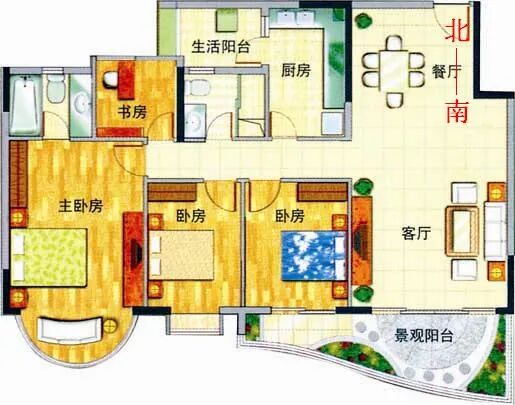
The master bedroom has a bathroom to its north — inauspicious. To its northeast are a bathroom and a kitchen. The bathroom cannot drain away all the kitchen's energy; taken as a whole the northeast is water, but water containing sand — auspicious with a trace of the inauspicious. To the east are two bedrooms and the living-room television — auspicious. Elsewhere zero. On the whole this flat's master bedroom is auspicious.
Note: in a flat, the entry door may be classified as water, but do not read fortune by the door, because the entry door is normally shut. If you get it right by the door, it is pure coincidence.
Reading a site means seizing the principal contradiction. A mistake that people trained in traditional feng shui make very easily is failing to distinguish principal from secondary. They walk in and say: “that painting hanging there is why you lost money this year.” The client did lose money this year, so the statement was correct — but the loss was not caused by the painting. It was probably caused by the kitchen, the bathroom, or the television, because a painting's energy is nothing beside theirs. (The painting, as an information field, can be used to predict what is happening to the client; but it is not the cause of what is happening. Many people think taking the painting down will change the situation, and in fact when the painting comes down the client's luck does not improve.) Change your thinking: do not assume that because your reading was right, the thing you named was the cause.
Source:WeChat public account “Shikongren Coordinates” (时空坐标) · by Lü Wenyi
Chinese original:城市楼房风水断法
Notice:This is a study archive. Copyright remains with the author. Nothing here constitutes advice.