Setting the Orientation in Natural-Science Feng Shui
Translator's note. The most systematic attack on orientation in the collection, and the one that states the underlying logic most plainly: the things around a point decide that point's fortune; the direction a box is turned does not change the things around it. Lü's apple-tree image — hanging a toy cat on a tree and turning its face, expecting the tree to change — is the whole argument in one picture. He also does something unusual here: he concedes that orientation may matter by three or five per cent, and then says that if you have the point right you may orient as you please. The passage on the three plates, and on the louse on an elephant, are worth reading twice.
On the question of orientation, traditional feng shui reached a conclusion — stated very explicitly in Liao Yu's Sixteen Burial Methods — that the sitting and facing of a house or a coffin should be fixed by the direction in which the vein's energy comes and goes.
And indeed: if orientation really were useful, and if obtaining the vein's energy depended on it, then one would have to orient along the direction of the qi's movement.
Two questions have to be considered. First, the direction in which the vein's qi comes and goes. Second, the place where the energy concentrates. Grasp those two and the whole question of what orientation to set is answered.
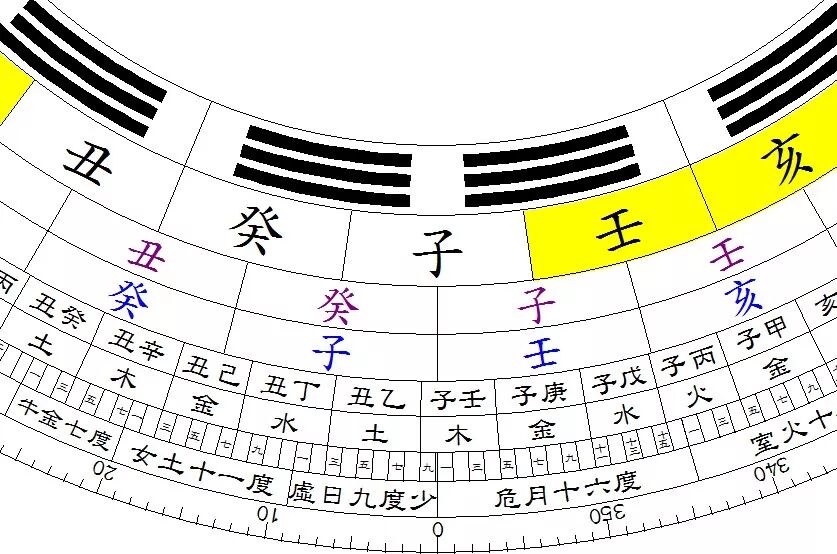
1. On “the direction in which the vein's qi comes and goes.”
If it is a vein-qi point, then one should orient along the qi's direction, since only so can the greatest energy be obtained. If the qi comes from the east and runs west, then sitting east and facing west is best.
But is that true in scientific terms? In practice, sitting north and facing south makes no difference either. The theory of orientation exists only because you believe orientation works. If you do not believe in it, it does not matter in the least what orientation you set. So: the qi runs from east to west — you may equally sit northeast and face southwest, sit north and face south, sit northwest and face southeast, or even sit west and face east, sit southwest and face northeast, sit south and face north, sit southeast and face northwest.
A house has a front, so it has an orientation. But for bones — and especially for ashes, or for a reburial of collected bones — there is no head and no feet. Where is the orientation then? Orientation is fixed by the direction of the head and the feet. Ashes have neither head nor feet: how do you orient them?
If you believe orientation has an effect, then orient along the direction of the qi's movement; and on that basis you may orient however you like by the Sanhe school's theory, the Xuankong school's theory, or any of the flying-star and liqi theories. What matters is that you get the dragon, the point, the sand and the water right — that the point you set is a true dragon point, a vein-qi point or a focal point. Once the point is well and accurately set, you may orient entirely according to whatever you were taught, or whatever the general public accepts, and it will have no effect on the feng shui at all — especially for collected bones and ashes.
If one insists that orientation affects feng shui, then only houses and intact corpses can have one. A corpse at least has head and feet: does the qi enter at the head and leave at the feet, or enter at the feet and leave at the head, or enter at the waist? If we are to believe in orientation at all, then only with a corpse is there a real relation between qi and body — that is, the question of how the qi enters the corpse: through the head, the shoulder, the chest, the waist, the feet?
As for building a house: if you believe orientation works, fine. The back wall's direction is the sitting, the front façade's direction is the facing. Choose your site, and build and orient according to any theory you have learned. Because in fact what orientation you set has, one might say, no great relation to the fortune of the house or the grave. Even if it has some, it is one or two per cent, or three or five per cent — that little. Of course the more auspicious the better, so you may orient by whatever theory you learned, or by the direction of the vein's qi. There is no difference between the two, because orientation simply has no great effect. What matters is where the point is; what matters is what every plant, every grain of sand and every stream around the point does to it.
Several arguments are made about orientation.
The first: the Dili Wujue holds that seeking the dragon, setting the point, examining the sand and finding the water are like sowing in spring and watering and fertilising in summer — and orientation is the autumn harvest. If you do not harvest, all the earlier work is wasted.
Is that so? Even taking the metaphor as given, the work is not wasted. Can I not go out to the field and eat the grain standing there? Why must I bring it home and store it? To store it I would have to build a barn. And without spring sowing and summer tending, what would there be to harvest in autumn? The dragon, the point, the sand and the water are the root of feng shui. Even if orientation works, it is like bringing the grain home so that it is convenient to eat in winter, or like improving the quality of the product a little. That is a fluctuating influence. Your act of harvesting does not decide whether there is grain in the field, nor whether there will be food in winter. What decides whether a man starves in winter is whether there was spring sowing and summer tending — whether anything grew in the field. If there is nothing in the field, what are you harvesting? If what you sowed in spring and summer was grass, is it any use bringing grass home in autumn? Will you eat grass at home when winter comes? So the traditional reading of orientation is itself mistaken; to treat orientation as the thing that decides a site's fortune is itself the error.
The second: the dragon, point, sand and water are like a building's materials and foundations, and orientation is the blueprint. Without a blueprint you cannot build; the blueprint is the decisive factor.
Can you not build without a blueprint? In the past, apart from imperial projects, who had blueprints? How many ordinary builders could even draw one? Even granting that a blueprint matters, it matters less than the foundation and the materials. Give me now the master plan of the Forbidden City: have you a foundation that size? Have you that quantity of materials? “Even a clever housewife cannot cook without rice.” The blueprint becomes useful only once there is a foundation and materials. Without them, what use is a drawing? I could sell you the plan of the largest and most beautiful skyscraper in the world, held in my head — would you buy it? But if I have a pile of sand, cement and brick in store, I can turn that into money. Even a man buying a blueprint buys it after he has the foundation and the materials. From this alone you can see that every traditional analogy offered to prove the importance of orientation collapses on examination.
The third: the fortune or misfortune of the whole sequence — dragon, point, sand, water — must be decided by orientation. Without orientation, the dragon, point, sand and water have no fortune at all.
That sounds quite right. But think again: they are talking about sitting and facing; we are talking about direction — about where, relative to a person at the origin, the surrounding sand and water lie: east or west, south or north. We are not talking about the box's orientation. Sitting and facing cannot decide the fortune of the surrounding sand and water. Suppose a computer stands to your north. Facing east, the computer is auspicious for you; would facing west or north make it inauspicious? Would facing northwest turn it into inauspicious sand? The theory sounds plausible until you go down to the essence of the thing, and then you see that it cannot survive the facts. No object changes from auspicious to inauspicious, or the reverse, because of the direction your face is turned.
Traditional feng shui is very obscure here. The ancestors never worked it out. They said: look, there is a tree in the east; on the earth plate it sits on the jia character, on the heaven plate it may be on mao, on the human plate it may fall on yi or on the boundary of jia and mao — so it is not the same, is it?
Let me put the most fundamental question. Whether it is a grave or a house: do the plants, the sand and the water around the place where you are building, or where you intend to put the coffin, decide the fortune of that origin — or does the sitting and facing of the house or coffin decide the fortune of the origin?
A plain example. Here is an apple tree. The apple tree is a mountain; the coffin is a child's toy cat hung on the tree — that is, you have put the coffin or the house somewhere on the mountain. Turn the toy cat's face: does the apple tree suddenly have apples to eat? Turn it again: does the tree lose its apples? Turn it again: does the tree die? Turn it again: does the apple tree become a pear tree? Is any of that possible? Not remotely.
So why did the ancestors say that the sitting and facing of a house or coffin decides the fortune of “this apple tree”? Because their theory rests on a very mistaken notion: that man is the soul of all things, that man can rule the universe, that man can decide the fortune of the world.
Remember: man is very small in this world. The house we live in, or our ancestor's coffin, is to the whole mountain range and the whole earth what a louse is to an elephant. Turn the louse's head — does the elephant's leg break? Turn it again — is the elephant's tail gone? Turn it again — has the elephant's head become a tiger's? Not remotely. The elephant's ear does not become a rump because a louse on its body turned its head. Our ancestors made a very serious logical error: they believed man could rule the world. He cannot.
The world is material; matter determines consciousness; consciousness reacts on matter, and correct consciousness promotes the development of matter while mistaken consciousness obstructs it. Objective laws do not bend to human will. Act according to law and a man succeeds; act against it and he certainly fails. Law is objective — it “does not exist because of Yao, nor perish because of Jie.” “The bolder the man, the bigger the harvest”: during the Great Leap Forward this boundless inflation of the power of consciousness, in defiance of natural and economic law, cost the new China enormous losses.
By the same token, if a theory of feng shui — a theory of the relation between people and environment — is built on the notion that “man can decide whether an environment is auspicious,” then you should understand that the whole system is more wrong than right. Human reshaping of the environment is reshaping to a degree; it cannot alter natural law. Earthquakes, tsunamis, volcanic eruptions, even hail and snow — we can do nothing about them. Turn your face and the hail will not stop hitting you; the flood will not go around you. What matters is whether you are in the gully. If you live in the gully, whatever the orientation of your house, the flash flood will destroy it. What matters is the actual relation between the house and the flood.
Every plant and every stream in the environment decides a person's fate, decides the fate of a house and a coffin. It is not the sitting and facing of the house or coffin that decides the fortune of the plants and streams around it. That is a question of fundamental logic, and the traditional theory of orientation is an absurd theory. In practice you may use orientation theory if you like: as long as you get the dragon, point, sand and water right, as long as the point is accurately set, you may orient however you please.
2. On “the place where the energy concentrates.”
The place where vein energy concentrates falls into one of two categories: it is either auspicious energy or inauspicious energy. When we build a house or place a coffin, we want to obtain the auspicious and avoid the inauspicious.
Since you hold orientation to be important, then when you orient you should point the person's head, or waist, or shoulder at the places where the auspicious energy is greatest, and turn the house or coffin away from the places where the inauspicious energy is greatest. You should watch, among the twenty-four mountains, for the strongest and the weakest auspicious and inauspicious energies: the auspicious at its maximum, the inauspicious at its minimum.
Take reaching for apples. In the east, at jia, mao and yi, there are three apples; in the northeast, at chou, gen and yin, three more; in the southeast, at chen, xun and si, three more — nine in all. Do we not reach for whichever apple is biggest, handsomest and best? The direction in which we reach is our orientation. We do not reach for the apple that is half eaten by worms; that rotten apple is the inauspicious energy, not the auspicious. To orient is to obtain the auspicious and avoid the inauspicious.
There is no secret to orientation. To put it precisely: once the dragon, point, sand and water are all in order, you may orient however you like. Whatever orientation you think is good is good.
Of course we may learn something of the traditional theories. The Sanhe school orients by the water mouth; that is one reading of orientation. The Xuankong school has its own. At one and the same site, one master says sit jia and face geng, another says sit yi and face xin; bring several masters of different schools to the same graveyard and their orientations will never agree. The traditional theory of orientation is precise, but it is a theory for fooling people: in practice it cannot be operated. Every operation is an estimate, and beyond estimating there is nothing — there is no way whatever to make orientation precise. A theory that cannot be operated and does not match the facts is an erroneous theory. That is the secret of orientation.
Source:WeChat public account “Shikongren Coordinates” (时空坐标) · by Lü Wenyi
Chinese original:自然科学风水学之立向
Notice:This is a study archive. Copyright remains with the author. Nothing here constitutes advice.