The Focal Point in Flat Country
Translator's note. A short, technical piece with an unusually clean rule in it. In flat country the old books looked for “water dragons,” because rivers were the only large energy-carrying features on a plain. Modern roads do the same job, and there are far more of them. The essay gives the geometric construction for locating the strongest focal point at a bend or crossing — the third vertex of an equilateral triangle — and then a table for deciding whether a given bend helps or harms. The caveat at the end is the honest part: these rules apply to focal points, not to vein-qi points, and a vein-qi point outranks an angle of water entirely.
On a plain, a focal point can be formed where a road or a river bends or crosses.
1. How to find a focal point.
Where is the focal point? There is a criterion. (See the figure.)
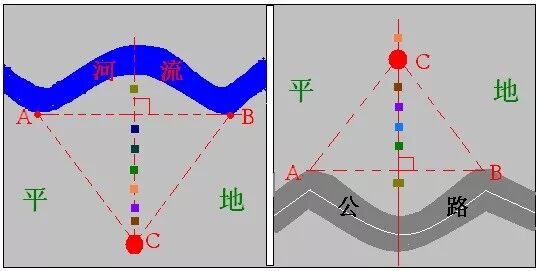
The focal point lies on the perpendicular bisector of the line joining points A and B. There are many focal points along that bisector, but what we want is the one of greatest energy, and that one can be calculated: it is at point C, the third vertex of the equilateral triangle ABC, where AB = AC = BC.
On a plain, a focal point formed by a bend or crossing of a river or a road carries a great deal of energy — much more than the surrounding sand and water: the houses beside it, the crossing water, and the rest. The focal point's energy is of a different order.
Flat-country focal points are auspicious or inauspicious. Practice shows that an auspicious focal point certainly produces wealth and rank; an inauspicious one certainly brings serious misfortune.
The old books on the plains always speak of finding the water dragon. In the past there were no roads to speak of, let alone railways, so on a plain the only large dragon was the river. In modern flat country, roads, motorways and railways also form focal points of enormous energy — and there are far more roads today than there are rivers.
Reading feng shui on a plain today, the first thing to look at is the focal point formed where a road or a river bends or crosses, because that focal point outranks the energy of angle water and of all the other sand and water.
Note carefully: focal points do not always lie on the centreline of the bend.
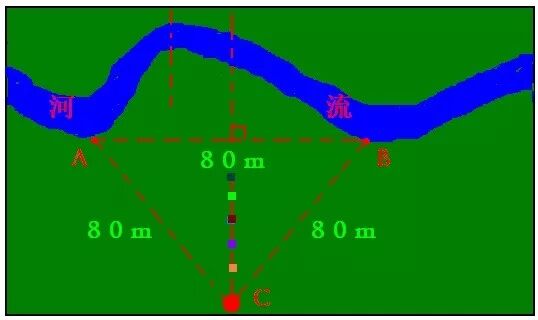
This is because landforms differ, and the place where the vein energy gathers therefore differs. It is a physical cause. In reality, most river bends are irregular.
The focal point at C carries the greatest energy. The points around C carry progressively less.
2. How to judge an auspicious or inauspicious focal point formed by a water dragon or a road dragon.
The auspicious and inauspicious character of sand and water by direction.
Taking the eight palaces:
- In the four directions east, north, southeast and southwest, sand is auspicious and water is inauspicious.
- In the four directions south, west, northeast and northwest, water is auspicious and sand is inauspicious.
By the same logic, focal points formed by water dragons and road dragons are judged as follows:
- In the four directions east, north, southeast and southwest, a focal point formed by a road dragon is auspicious, and one formed by a water dragon is inauspicious.
- In the four directions south, west, northeast and northwest, a focal point formed by a water dragon is auspicious, and one formed by a road dragon is inauspicious.
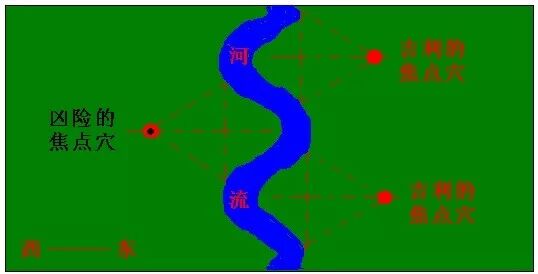
Water in the east is inauspicious, so a focal point formed by a river bend in the east is inauspicious. Water in the west is auspicious, so a focal point formed by a river bend in the west is auspicious.
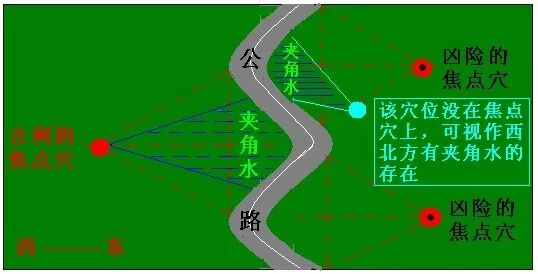
Sand in the east is auspicious, so a focal point formed by a road bend in the east is auspicious. Sand in the west is inauspicious, so a focal point formed by a road bend in the west is inauspicious.
A road bend in the east gives an auspicious focal point. But someone will ask: a road bend in the east also forms inauspicious angle water — so which is it? As long as it is a true dragon point, as long as it is a vein-qi point, its energy is the greatest, and beside a vein-qi point, angle water counts for nothing.
All of the above applies to focal points. If the point in question is not a focal point but a sand-and-water point, the points on either bank of the river or road are judged differently.
On a plain, a focal point formed by a water dragon or a road dragon is in practice equivalent to a vein-qi point — but we cannot call it one, because it does not sit in the qi-bearing layer.
Source:WeChat public account “Shikongren Coordinates” (时空坐标) · by Lü Wenyi
Chinese original:平洋地的焦点穴
Notice:This is a study archive. Copyright remains with the author. Nothing here constitutes advice.