There Are True Dragon Points in City Buildings Too
Translator's note. The companion to “Reading Feng Shui in an Apartment Block”, and the more provocative of the two. If you accept that two flats in the same stack have identical surroundings, then the sand-and-water method cannot distinguish between them — which is exactly why the trade invented floor-selection rules. Lü's alternative is to compute where the ground planes of the neighbouring blocks neutralise one another, and read the floor at that height. Two field cases follow, with outcomes stated flatly. Whether or not one accepts the mechanism, the argument that floor-choice lore has no basis is well made, and the two case records are unusually specific.
In mountains or on plains, in cities or in villages, true dragon points are everywhere. The greatest energy belongs to the vein-qi point on the stratum that carries the vein's qi. Next comes the focal point formed by a combination of sand and water — which can only be called a sub-true dragon point, since its energy is not comparable to a vein-qi point. Then there are the sand-and-water points found by orientation and the examination of sand and water, which hardly deserve the name at all: their energy is very much smaller than a focal point's.
But whether vein-qi point or focal point, all of them differ in the size of their energy and in its auspicious or inauspicious character. Not every true dragon point produces ministers, and not every true dragon point is auspicious. How to judge which is which we will leave aside here.

I want to talk about feng shui in city buildings. In the city we normally judge by sand-and-water orientation. But consider a single stairwell in a block where every floor from the first to the top has an identical plan: from the point of view of sand-and-water orientation there is no difference in the external environment at all, and usually no great difference in the interior either. From the ground floor to the top floor, the sand and water on the ground do not change the fortune of one floor relative to another — all that changes is that their influence weakens as the distance grows.
So if a flat's sand-and-water orientation is auspicious, our masters conclude that all hundred flats from the first floor to the hundredth have the same fortune, and the only question is what kind of fate the occupant has. Hence the many theories for choosing a floor. Objectively speaking, those theories are castles in the air with no correct theoretical basis whatever. They are armchair theory.
Is there, then, in a city building, a standard whose energy is far greater than sand-and-water orientation? There certainly is: the true dragon point — the focal point. Every building has focal points, and every building's focal points are some auspicious and some not. The focal points of a city building can be evaluated by a scientific, mathematical calculation, and the standard is precise and scientific. If the building's focal point carries auspicious energy, the occupants are fortunate; if inauspicious, they are not.
Before the examples, a simple diagram of how to find a building's focal point. (The theoretical basis, briefly: the focal point is the position at which yin qi and yang qi are neutralised.)
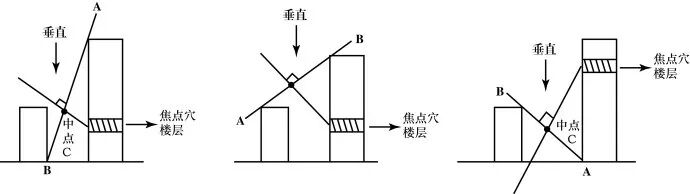
Two examples.
1. Meizhou, Guangdong. A few days ago I was reading a building for an official in Meizhou. He lives on the second floor of a six-storey block; a five-storey block stands to its east. Judged by sand-and-water orientation, all six flats in his stairwell, from the first floor to the sixth, are highly auspicious — all eight directions favourable. If all eight directions are favourable, and the layout of floors one to six is identical, then all six should be fortunate. Without knowing who lives on which floor, which master could say which of those six floors is best and which worst? The focal-point theory answers it easily. As established, a focal point's energy is far greater than a sand-and-water point's; what sand-and-water orientation evaluates is only a sand-and-water point. And if a sand-and-water point happens to sit on an inauspicious focal point, very little of its auspicious meaning survives.
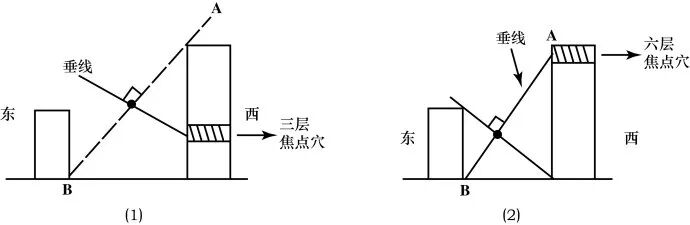
Figure 1 shows the focal point formed by the ground planes of the six-storey block to the west and the five-storey block to the east: it falls at the third floor of building A. Figure 2 shows the corresponding focal point on the opposite side: it falls at the sixth floor. So the third and sixth floors of building A are both focal-point floors. The official lives on the second. Because the energy at both of those focal points comes from inauspicious sand to the west, both are inauspicious. I predicted that once people moved in on the third and sixth floors, disasters would follow one another.
The facts: on the third floor the husband's career stalled and the daughter suffered a calamity; on the sixth floor, from the day the family moved in, misfortunes came one after another and the family fell apart. Floors one, two, four and five were all peaceful, smooth and fortunate.
2. An army family compound at Lugouqiao, Beijing.
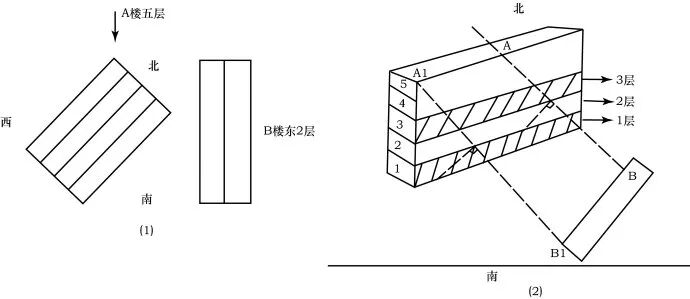
Buildings A and B meet at an angle. For building A, the further north you go, the narrower the gap between A and B; the narrower the gap, the lower the point at which the perpendicular bisector of the line joining A and B crosses building A — down at the first floor. The further south in building A, the wider the gap; and as the gap widens, the crossing point rises to the third floor. So for the four stairwells of building A running north to south: the northernmost focal point, in stairwell 1, is at the first floor; in stairwells 2 and 3 at the second floor; and in stairwell 4, the southernmost, at the third floor. And because the energy at these focal points comes from inauspicious sand to the west, all of these floors are inauspicious.
This was a case I read. The facts: in stairwell 1, first floor, the husband died and the mother and child were left alone in poor circumstances. In stairwells 2 and 3, second floor, every household suffered serious calamity. In stairwell 4, the occupant had been a factory director; after moving in he took up with a woman, was badly cheated, and cost the state-owned enterprise over a million yuan — he made the money good out of his own pocket and loans, escaped prison by a hair, and fell into depression with a standing inclination to suicide.
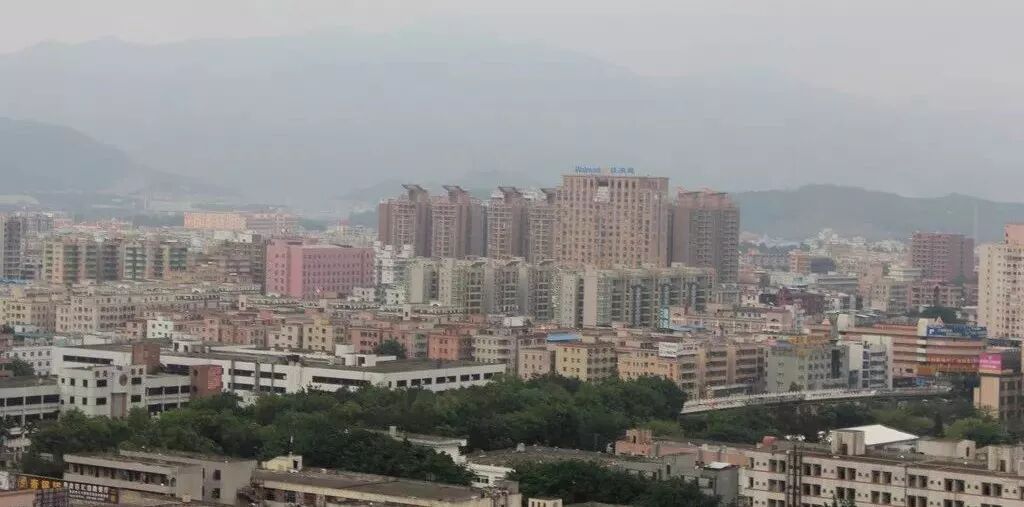
Clusters of buildings can form focal points of even greater energy.
From these two examples I believe friends can see which theories in this field are scientific and which are armchair theory for fooling people. The real theory for judging city buildings and floors is the theory of seeking the dragon and setting the point. Here we have discussed only the focal points between buildings; there are focal points of far greater energy formed by clusters of buildings, and using the energy of such a point — when it is auspicious — can produce descendants of great wealth and high rank.
With this theory we can find, in a city's blocks, the building and the floor with the greatest auspicious energy, and live there in great good fortune. We can equally find the building and floor with the greatest inauspicious energy, and so avoid harm and live in peace. If you want to change your own fate, or to become a master of the first rank, then learning this theory is the only and the best choice.
Source:WeChat public account “Shikongren Coordinates” (时空坐标) · by Lü Wenyi
Chinese original:城市楼房中也有“真龙穴”!
Notice:This is a study archive. Copyright remains with the author. Nothing here constitutes advice.