Where in the Strata Does Vein Energy Accumulate?
Translator's note. A field manual in disguise. Two rules about where energy collects — downstream of a dipping layer, and in the layer of lower density — are followed by the practical question every grave-digger faces: how deep? Lü's answer is that the old books' inch-measurements are useless because they were groping after something they could not name, and that the real criterion (stop when you reach the five-coloured earth) is a density test in plain clothes. The essay then turns to the east–west asymmetry that decides whether a slope collects energy or scatters it, which is the most mechanically specific argument in the collection. One paragraph of curses against plagiarists has been reduced to a note, and a telephone number appended to the text has been removed.
1. Vein energy accumulates downstream of a dipping stratum.
Because of gravity, everything on earth must move from above to below. So the greatest quantity of vein energy gathers on the downstream side of a sloping layer.
2. Vein energy accumulates most in the stratum of lower density.
Density is the amount of substance per unit quantity. In physics, the mass of a unit volume of a substance is called its density. Steel is denser than cotton; stone is denser than soil. Why does more vein energy gather in a low-density layer and less in a high-density one? Because the lower the density, the greater the gaps between molecules — which in effect increases the surface area. A material with more surface area can absorb and hold more of other materials and of energy. Suppose every molecule of rain falling from the sky were a unit of vein energy: a ball of cotton and a block of steel of the same volume — the cotton will hold far more water molecules than the steel. So a low-density stratum holds more vein energy than a high-density one.
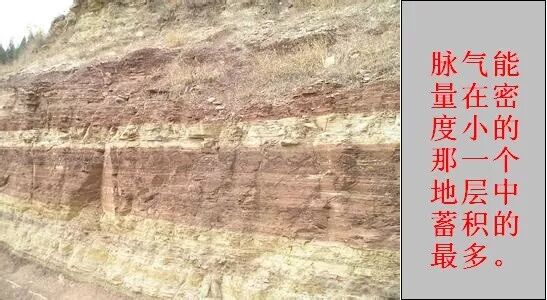
This figure also bears on how deep to dig a foundation, or a grave. How deep is auspicious? The old books give many measurements: one foot eight, three feet six, three feet eight, four feet five, four feet eight, five feet five. But none of them fixes an invariable figure. Why did the ancients give so many depths and never tell us which one is auspicious? Most practitioners have never thought about it.
The truth is that the ancestors could not tell you how deep to dig a particular pit, because different landforms require different depths. So how did they judge? They had one criterion: stop when you reach the five-coloured earth, or earth that is clearly auspicious.
In practice, one site may reach the auspicious earth at two metres; another at twenty centimetres. Dig deeper and you may cut through the layer — and if the layer is cut, the vein energy drains away and you get none of it.
The ancients had no concept of strata, but they did talk about five-coloured earth. Understand: a change in soil colour is in substance a change in soil density. Where density does not change, colour generally does not either. On the loess plateau, dense soil looks darker; less dense soil looks paler. In the south the colour changes are more various — red, white, yellow, purple, layer upon layer, each distinct. The ancients had already noticed the strata; limited by the science of their time, they did not pursue it. So they told their descendants: dig until you reach the auspicious earth, and stop. Their explanation was not scientific, but seen through the lens of strata it is clear why they refused to lay down a hard rule of four feet eight or five feet five.
In actual practice, local grave-diggers mostly fix the depth by local custom. In Hequ county, Shanxi, the usual depth is five feet five. In the Lüliang region, pits go as deep as six to nine metres. The younger the deceased, and especially where the death was violent, the deeper the pit — nine metres. The reasoning is simple: only if the dead are buried deep will the ghost be pressed down and unable to come out, unable to go home and harm the living. For an old person of eighty or ninety who died a natural death, the pit is about three metres. All of this is local folk custom and the habit of the local grave-diggers. So what is the right depth for a foundation, or for a grave? The criterion should be: dig to the layer where the vein's qi is most concentrated and holds the most energy.
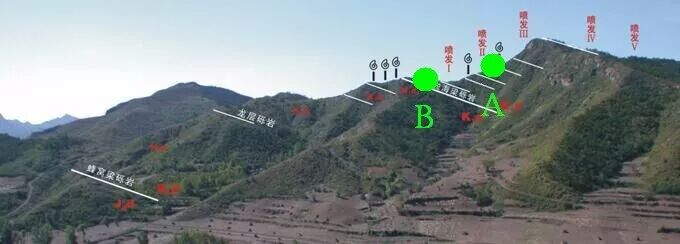
A mountain like this looks continuous, and its form is well made. Setting aside the surface energy gathered by the shape of the land, and looking only at the energy in the strata: here the direction of the strata's energy does not agree with the trend of the mountain. Set a point at A and you get no vein energy, and nothing auspicious will happen.
(The original interrupts the article here to say that because plagiarism is rampant in the trade, the author reserves some core material for his face-to-face classes, and appends a curse on anyone who steals his writing. The curse has been omitted.)
In practice, when looking for a point we must consider both the energy underground and the energy on the surface. If the two coincide, the fortune is great. If they do not, we must at the very least obtain one of them — either the underground vein energy or the surface energy.
In the figure above there is a point at B which cannot obtain the underground vein energy. Suppose the terrain runs high in the east and low in the west. We know that the earth's revolution and rotation both run from west to east. The vein energy that is useful to us falls to the ground from space, and then gravity draws it toward B — so the point at B will produce wealth and rank. This is the scientific reason why sand in the east is auspicious.
Conversely, if the terrain runs high in the west and low in the east, then B gets no underground energy, and although the energy falling from space would in theory be drawn toward B by gravity, the earth's rotation and revolution generate a force running from east to west. The two opposing forces make the energy on the western slope chaotic and unusable. Energy that cannot be used we describe as inauspicious — not because the energy is in itself bad. This is the root reason why two identical landforms can differ in fortune according to the direction of the slope.
Traditional feng shui, unable to explain this, goes wrong again and again in practice. The same landform: a point on this hill produces wealth, a point on that hill produces nothing or runs of bad luck. Unable to find the cause, practitioners transferred the question to the water mouth and to orientation, hoping to solve by orientation why identical configurations differ in fortune. The ancestors could not solve it; the Guolu Yinyang — the Golden Lock and Jade Gate — tried to. But the Guolu Yinyang is a summary of experience with no theoretical basis at all. Some clever practitioner noticed in the field that sand in the east is auspicious and water in the east inauspicious, that sand in the west is inauspicious and water in the west auspicious, and composed a great many mnemonic verses and made them into a book. He never raised the experience to the level of theory. Experience is no substitute for theory, which is why the verses of the Guolu Yinyang prove inaccurate in many cases in the field. Water in the east is supposed to be inauspicious — yet some families with water in the east prosper very well. And the original text of the Guolu Yinyang contains no theory of sitting, facing and fenjin at all; the fenjin material now printed in editions of the book was shoved in by modern hands.
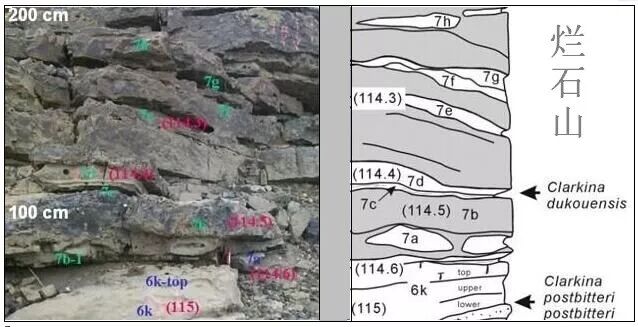
By traditional reckoning a rubble mountain like this holds no energy at all. It is called a “broken army mountain,” a place where nothing may be buried.
In reality, in Shandong, Gansu, Ningxia and much of the south, mountains look exactly like this — and they too produce wealth and rank. Someone may ask: does the vein energy not simply run away? Yes, some of it certainly runs away. But how much each household receives is a comparative matter. Every household's water pipe leaks; the household whose pipe leaks least gets the most water. On a rubble mountain some loss is normal; no stratum is ideally complete. If the energy is auspicious, then the household whose point loses least of it will be the one that prospers most.
Understand that the energy in the strata is extremely stable. It is very hard to destroy — unless you cut a mountain or bore a tunnel, there is in general no way to damage it. By contrast, the energy formed on the surface by the shape of the land is unstable. Plant a row of big trees beside the house, set up a gravestone, put up a cowshed next door — any of these will have a large effect on the feng shui. Any change whatever in the surface landform changes where the surface energy gathers and how much gathers there.
Traditional feng shui says that building a temple on a mountain will suppress the dragon. Dynasty after dynasty, emperors afraid of rebellion built temples all over the country to pin the dragons down. Did it work? Not in the least. The idea belongs to feudal superstition. The dragon is a protector of the Bodhisattva — how could the Bodhisattva press the dragon to death? If you keep a fine horse to ride, do you go home and strangle it for something to do? The Bodhisattva is all compassion: if the dragon suffers, she suffers; if you suffer, she suffers. Why would she suppress it? Many people in this trade understand nothing and simply assume that a temple will pin a dragon down. It will not. There is no point discussing this superstitiously, and still less point discussing it scientifically.
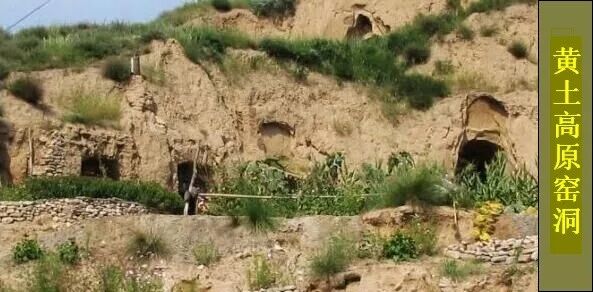
The cave dwellings of northern Shaanxi and the Shanxi loess plateau have no hills around, no water embracing, no hollow, pincer, breast or mound. Obtain the auspicious vein energy from the strata and they produce wealthy and honoured people all the same.
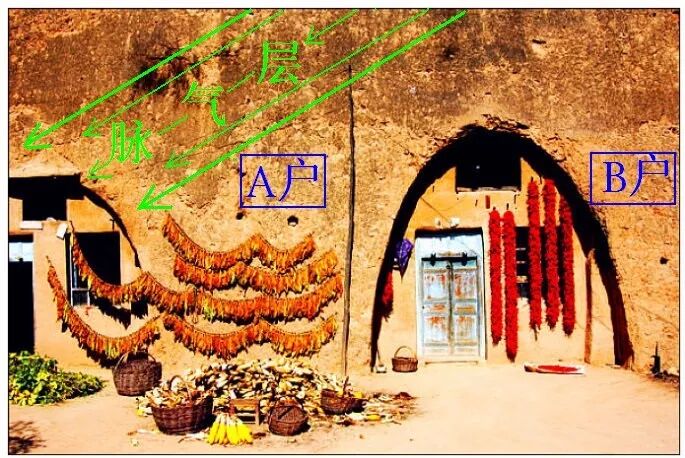
Suppose these are two neighbouring cave dwellings. The vein energy in the strata enters household A and cannot enter household B. B gets nothing — and the difference in fortune between the two households will be enormous. On the loess plateau you see it among brothers: three of them marry and live in three adjoining caves, and every child born in one cave turns out able, while every child born in another is dull, or dies young. On the loess plateau most wealth and rank comes from vein energy in the strata, not from energy gathered by the surface landform.
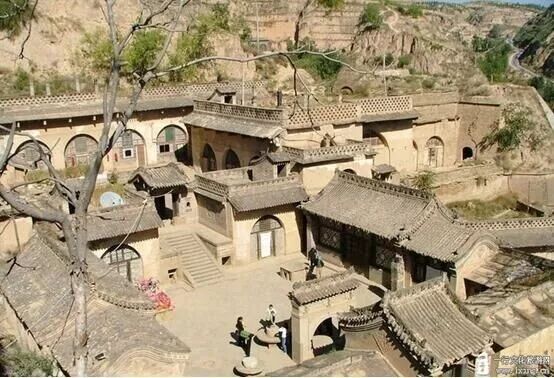
This is the ancestral home of a large landowner on the loess plateau before 1949. The compound happens to sit exactly on the qi-bearing layer; all the auspicious vein energy went into his household. Even the neighbours who sat on the same layer were robbed of it by the landowner's house. That is what “grabbing the feng shui” means. And in fact the families around the landowner's house were all ordinary peasants.
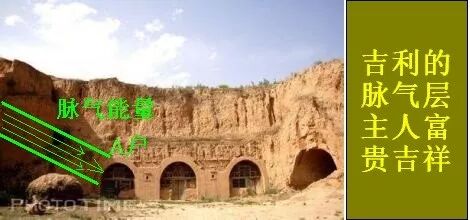
If the auspicious layer flows only into household A, A will have wealth and rank and the others will have none. But if the land here runs high in the north and low in the south, and the vein energy comes from the north, then several households will benefit — even the pets and livestock kept there will live happily. Auspicious vein energy is useful not only to people but to animals, and even to objects. In real life, a parking space affected by inauspicious vein energy is forever being scratched or involved in accidents. The stretches of road where serious crashes keep happening are, in substance, caused by the feng shui environment.
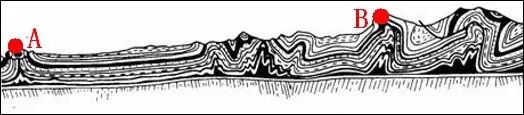
Suppose the shaded band is the qi-bearing layer. Setting a point on either hill A or hill B is what traditional feng shui calls a “heaven point,” and the method is what it calls “contracted burial.” Put the point on A and you get vein energy, and wealth. Put it on B and you get nothing at all — B not only fails to receive the stratum's energy, it loses its own. In real life a heaven point rarely makes anyone prosper, because it is very unusual for the energy in the strata to return all the way up to a summit.
Source:WeChat public account “Shikongren Coordinates” (时空坐标) · by Lü Wenyi
Chinese original:脉气能量在地层中的什么地方聚积
Notice:This is a study archive. Copyright remains with the author. Nothing here constitutes advice.