Can the “Sitting and Facing Fenjin” Theory Actually Be Applied?
Translator's note. Five questions, asked in public at a national conference, which between them dismantle the zuoxiang fenjin method without anyone having to raise a voice. The fourth is the one that ends the conversation: if you set the sitting by the centreline of the coffin, have you opened the lid to check that the bones are on that centreline? The essay is short because it does not need to be long. Read together with “Setting the Orientation” and “Can the Fenjin Method Be Applied?” it forms a single, patient demolition.
Zuoxiang fenjin — sitting, facing, and the fenjin — means the directions of the front of a house (the facing) and the back (the sitting), or the direction of the head of the corpse (the sitting) and the feet (the facing) in a grave. The “sitting and facing” is the general direction within a range of fifteen degrees; the fenjin is a further and finer determination within a range of a few degrees.
Chinese traditional feng shui, as it was handed down, produced this situation: because the sitting-and-facing-fenjin theory is the easiest thing in the whole subject to learn and apply — a man with no education at all can master it in a day or two — this most useless and least scientific theory spread everywhere and was accepted by great numbers of people. It also became the main trick of the swindlers in the trade. Meanwhile the most scientific and practical theories in Chinese feng shui, being beyond the grasp of the average person, were abandoned and forgotten.
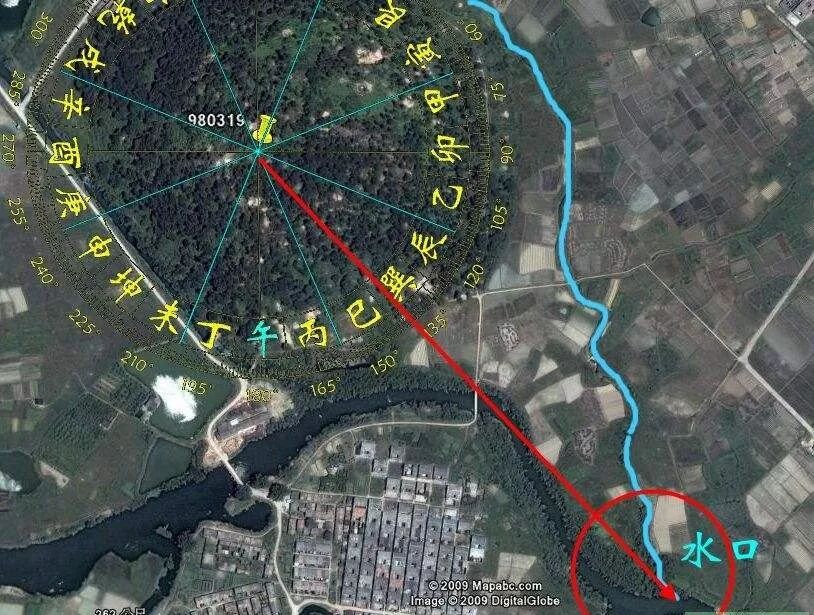
Traditional feng shui treats the fenjin theory as extremely important, holding that it is a decisive cause of a site's fortune. At a number of national feng shui conferences, in front of every master lecturing on how the fenjin theory decides a site's fortune, I asked only four questions.
Question one: when you bury a dead person, do you set the orientation and fenjin by the centreline of the coffin (or the urn), or by the centreline of the corpse?
Every master said: by the centreline of the coffin or urn.
Question two: according to your own theory, should the orientation and fenjin be set by the centreline of the bones, or by the centreline of the coffin?
Every master answered: in theory, by the centreline of the bones.
Question three: when the coffin is lowered into the pit, are the coffin's centreline and the bones' centreline one hundred per cent coincident?
Every master said: not necessarily — the bones can shift sideways in the coffin, or tilt.
Question four: since at burial the bones' centreline and the coffin's centreline are not necessarily coincident, why do you set the orientation by the coffin's centreline? When you set it that way, have you ever opened the lid to check whether the bones lie on that centreline? Are you setting an orientation for the dead man, or for the box? Are you burying a box, or a person?
At this point none of the masters could answer, or ever did.
Question five: in a reburial of collected bones, or a burial of ashes, how do you tell the head from the feet? If you cannot separate head from feet, how can you possibly set a sitting and a facing, let alone a fenjin? Is this not deceiving yourself and others?
So: this theory, flawless on paper, cannot be operated at all in practice. What does that show? Only that the sitting-and-facing-fenjin theory is an armchair theory; that it cannot decide a site's fortune at all; and that the masters who propagate it do not understand the fundamental theory of the subject, and can only use this armchair material to impose on clients and students. There are at least a hundred further objections to the fenjin theory and to the use of the compass; the interested reader may consult my blog or this account. There is no need to go further here. I hope friends will form a correct understanding of the fenjin theory, and not ruin themselves with it and then go on to ruin others.
Source:WeChat public account “Shikongren Coordinates” (时空坐标) · by Lü Wenyi
Chinese original:风水“坐向分金”理论具有可操作性吗?
Notice:This is a study archive. Copyright remains with the author. Nothing here constitutes advice.