Telling Sand From Water (Part 1)
Translator's note. The first half of a long practical piece on classification: is this thing in front of me sand, or water? Lü's answers are more interesting than the question. A fridge is sand even though it contains cold air, because nobody sits with the door open. A row of trees is sand that also behaves like water, which makes it the single most useful adjustment tool in the collection — it works whichever side it is on, reducing the effect of whatever lies behind it. The long detour through colour, smell and the physiology of perception is there to make one point: sand and water are placeholders for energy, and energy reaches us through the body, not through symbols. One paragraph of curses against plagiarists has been reduced to a note.
1. Factories.
Every factory is sand.
A mineral water bottling plant is sand too, because its water is not sitting out in an open tank; it is enclosed. Modern high-tech livestock sheds are classified as sand.
2. Electrical appliances.
Every electrical appliance is sand.
Televisions, computers, stereos, mobile phones, telephones, microwave ovens — all sand. Even an electric razor is sand. A refrigerator is sand.
Many books say: open the fridge door and cold air comes out, so cold air is water, not sand. But who in real life buys a fridge and leaves the door open all day letting the cold out? Even letting it out, the door is open briefly, to put food in or take it out. Reckoned by the physics of work, producing a thousand kilocalories of cold costs at least a thousand kilocalories of heat; energy is conserved. So whether the fridge door is open or shut, a fridge is classified as sand. A water dispenser is sand, because its water is fully enclosed. A washing machine is sand, because a fully automatic machine washes with its water enclosed, and an ordinary machine is not running twenty-four hours a day.
In an appliance showroom, where appliances are everywhere, the stalls selling appliances in the middle cannot treat the surrounding appliances as sand. This is a balanced system, and inside a balanced system there is no such thing as sand and water — just as a man in air, or a fish in water, has no need to decide whether the air or the water is sand.
3. Plants.
Plants, flowers, grasses and trees are classified as sand, but they also perform the function of water.
First: plants have an adjusting function in feng shui.
Flowers, grasses and trees are sand in themselves, but they release water molecules into the air every second, so where there are plants the humidity is higher. We can therefore regard plants as neither sand nor water — which is exactly why they are so useful in adjusting a site. (See the figure.)
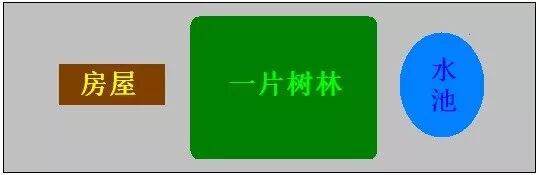
Suppose there is a stand of trees between a pond and a house. Consider: is there a difference in energy between the pond's effect on the occupants with the trees and without them? Certainly there is. Here the trees are acting as sand — as a barrier — and in that case the pond's effect on the house drops sharply.
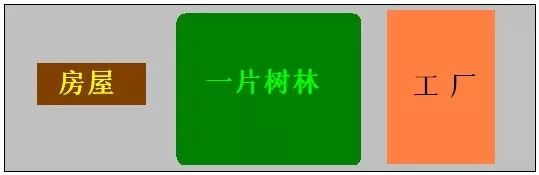
Suppose there is a stand of trees between a house and a factory. With the trees and without them, the factory's effect on the occupants is certainly different.
First, the factory's noise and dust will have much less effect on the occupants; even its noxious gases will have less. Because the trees block, and because the trees themselves constantly transpire moisture, which means they also act as water. The more trees and the larger they are, the greater the barrier, and the more their water function shows. Of course, when trees stand beside a pond or a river they also give off moisture, but compared with the water of the pond or river their contribution is small enough to ignore — and in that situation the trees are acting as sand.
Understand this, and you understand that plants play an important part in adjusting a site, with very obvious results.
Suppose the factory lies in an inauspicious direction. With a stand of trees in between, the factory's bad effect on you is greatly reduced. Conversely, if the factory lies in an auspicious direction, a stand of trees in between will reduce its good effect. If a pond lies in an auspicious direction, trees between will reduce the pond's good effect on you. And if the pond lies in an inauspicious direction, trees between will equally reduce its bad effect.
Houseplants in pots work the same way; the only difference is that a potted plant has less effect than a tree planted outside. The larger the volume of the plant, the greater its power to adjust a site.
Second: the mistaken view of plants in feng shui.
Many feng shui books now on the market say that trees divide into yin and yang: tall trees are yang trees, short trees are yin trees; pines are yang, willows are yin, and so on. On what criterion they divide a tree into yin and yang, I cannot imagine. Frankly, this is nonsense. Of course, if you insist on dividing trees into yin and yang, that is your affair. But let me ask: planting pines between a factory and a house, and planting willows between them, does make a difference — yet once you set aside the degree of effect, all trees do the same job in feng shui. How can one call them yin and yang? If the distinction meant anything, it would mean this: if a factory is harming you, planting yang trees in between would make the harm greater, and planting yin trees would make it disappear, because the yin trees would dissolve all the factory's yang. The absurdity collapses under its own reasoning. Students have no need to memorise any of it. In choosing and adjusting a site we should solve the problem at the root.
On the question of which trees to plant in a courtyard, some say you must not plant mulberry, sophora, pear or peach — because sang (mulberry) sounds like sang (mourning), huai (sophora) like huai (bad), li (pear) like li (separation), tao (peach) like tao (flee). All inauspicious puns. This is folkloric feng shui. In the silk districts of the south, mulberries grow inside and outside every courtyard, and the peasants make a good annual income from them — where is the harm? Shenzhou, on the central Hebei plain, is a famous producer of honey peaches, pears and apples; most of the county's farmers grow exactly these crops, live in peace and prosper, and hardly any of them “flee” their home district or suffer “separation in life and death.” In real life, are there no separations and bereavements in households with no pear tree in the yard? Bereavement has no relation whatever to whether a pear tree is planted.
Others say you must not plant pine or cypress in a courtyard, because pine and cypress are trees for temples and graveyards. This too is folkloric feng shui with no scientific basis.
(The original repeats its warning about plagiarism here and appends a curse. The curse has been omitted.)
Third: points to watch when planting.
- If you are reading a site for someone, do not plant what the local people consider taboo. Respect local custom; do not add a stone to your client's shoe. Custom is a habit formed over thousands of years and handed down; once formed it is sacred in people's minds, and science itself is sometimes helpless before it.
- Planting should follow the principles of natural-science feng shui and of natural science itself.
Does planting carry any meaning for fortune? Certainly it does. But it is not the case that planting a peach tree makes you flee; plant an apple tree and you may flee just the same. It is not the case that a pear tree causes divorce; plant an apple and divorce still comes. It is not the case that a mulberry brings bereavement; old houses lived in for generations with no mulberry in the yard still see deaths.
From the standpoint of feng shui, what matters is which direction you planted in, where in the courtyard, where around the house — that is the root, that is the main factor.
Which species you plant is a secondary factor. From the standpoint of scientific knowledge, which flowers are best to keep at home? Green or red? White or black? That is another question.
First: every client, and every one of us, has personal tastes.
Second: which flowers may be kept in a room and which may not is itself a scientific question, because different plants differ enormously in their chemical volatiles, and different volatiles have completely different effects on the same person. So what you plant around your home, in the yard and indoors does bear a fairly close relation to a person's fate. A single tree cannot decide our fate, but it can influence it to some degree. Which flowers belong in the bedroom, which in the living room, which trees in the yard and around the house — these should be decided on scientific grounds.
Third: every plant has physical properties, expressed in its shape and colour. Plants of different form affect the mind and the body differently; plants of different colour do too.
A thing affects the mind through its effect on the body. The energy implicit in a plant's shape and colour stimulates the body. A red flower, for instance, projects the red band of the light spectrum into our eyes; the energy of that band stimulates the eye, and only then do we form a thought. Cover our eyes and a red flower, a blue flower, produce no mental activity at all. Every mental event arises after some external material thing has stimulated us. Without the influence of the material world a person would be as good as dead, and would have no mental changes whatever. Put a pot of red flowers in front of a corpse and it will not blink, because it is not receiving the flower's influence — so where would a mental change come from?
Every mental change comes from the energy of external things acting on us. It is because external energy affects our body that we have mental changes — not the reverse, as though a thing changed our mind and we then discovered that our body had been disturbed. If I stick a needle in your arm while you are not looking, do you first have a mental change or first feel pain? Do you first hate me and then feel pain, or first feel pain and then hate me? You feel pain first, and only then form the mental response — resentment, or amusement, or curiosity.
This world is a material world. All spirit is built on a material base; without matter there is no spirit. This is the philosophical position that matter determines consciousness.
Then can there be spirit without matter?
Yes — because spirit is itself a form of matter. “Matter” in philosophy means everything that objectively exists: what we can see, touch and feel, and also what we cannot see, touch or feel. Spirit is simply matter that our eyes cannot see and our flesh cannot feel. The latest research has demonstrated the existence of gravitational waves, further confirming Einstein's general theory of relativity — and yet we cannot feel gravitational waves. Think of radio waves: who can feel a radio wave? We do not know which waves pass through our brains, whether long or short, ultrasonic or infrasonic — and those waves are objectively existing matter. So we may regard such waves as the existence of spirit. Spirit is a form of matter, and this world is a material world.
When is spirit not matter?
Only when, in religious language, you “leap out of the three realms” — then spirit and matter unify completely. As long as you are on this earth, spirit is matter. If the Buddhas and Bodhisattvas were not material, how could they manifest? Their manifestation in the sky is not matter? If they were not material we could not see them. So Buddhas and Bodhisattvas are material too. The only difference is that if we cut off a finger we cannot stick it back on, whereas their matter is of a special kind that can compose itself into anything at will: they can take themselves apart and still live, while we take ourselves apart and that is the end of us. That is the whole difference. So Buddhas and Bodhisattvas are material; otherwise we could not see them, and they could not manifest in order to demonstrate their greatness and wonder.
In short, our mental changes are caused by material changes. Which means that what we grow at home affects us very differently from one plant to another.
You may ask: will keeping a pot of flowers really bring me disaster? Possibly, and possibly not. Why? Possibly, because the chemicals or the physical state implicit in that plant really are closely connected with you. Suppose you have allergic rhinitis and the flowers you keep shed pollen every day, in large quantities — will that not affect your health? Suppose your eyes water in bright light, and every plant you keep is white, or as vivid as a scarlet lily: the more vivid the colour, the stronger its action on the eye, and a green plant would be better for you. So if you are highly sensitive to certain plants, then yes, keeping them may really affect your fate, even change it. If you are not sensitive, the relation is simple: the greater the plant's energy, the greater its effect on you; the less, the less.
How do you judge a plant's energy?
Physically: a plant of greater volume has more energy than one of smaller volume. Chemically: a plant with more harmful volatile compounds has more energy, and does us more harm; a plant with fewer has less energy and does less harm. Conversely, a plant with more energy and more of the beneficial compounds does us more good. So the question of plants should be approached scientifically. Dividing them into yin and yang solves nothing. In a field, a courtyard or a graveyard, the chemical volatiles of plants have little effect on us, so plant whatever you like. But for flowers in a bedroom, or wherever you spend your time, you would do well to look into the plant's volatiles and its physical properties.
Why does colour affect us so strongly?
Colour in itself has no meaning. Colour is the result of an object reflecting different bands of the light spectrum, and different bands have completely different effects on people. Powerful ultrasound can kill any animal quickly; in that band, a wave can kill a person instantly without their feeling anything. By the same token other bands — the red band, the yellow, the blue — have their own effects. So it is not colour that affects us; it is the energy of a particular band of light. Colour is not in itself the meaning of water, wood, metal, fire and earth. Colour affects us as wavelength affects us — as wave energy affects us.
In practice we should read everything scientifically. Suppose you advise a client to wear green and not black, and you tell him green is wood and black is water, that he likes wood and not water. Is that wrong? Not exactly — but it is not persuasive, and a scientifically literate person will not believe it. The client does not know what water, wood, metal, fire and earth are, and thinks it is superstition. But tell any scientist that different colour bands affect us differently, and not one will call it false.
Taste works the same way. Smell something foul and everyone turns away at once; smell something fragrant and most people take another breath. And people also take another breath of a foul smell — do you believe it? We look twice at a beautiful woman; we also look twice at an ugly woman. Why? The beautiful woman's energy is great, so her impact on us is great; the ugly woman's energy is also great, so her impact is great too — it is simply negative energy. Smell is the same. When the air carries no smell at all, nobody consciously takes an extra breath to check what it tastes like; but a sudden fragrance or stench stimulates the nerves very strongly.
Modern science has established that in this world colour and touch both need a process before the brain responds. Only smell acts on thought directly. The olfactory cells differ from every other cell: smell acts directly on the brain, whereas sight cannot. A thing first stimulates the eye, and the optic nerve carries the signal slowly to the brain's visual centre. That is why we identify a smell faster than anything else. Put a vivid flower and a bad smell in a room, and the person entering registers the smell first. If the smell is strong, he will not notice the flower at all. Scientists have found that smell outranks every other sense in speed. Walking down the street you do not notice the many women passing, but let one walk by and a scent drift over, and you turn your head at once to see where she is.
Which means that smell too can change a person's fate. How? Different flowers have different scents; keep the kind of flower whose scent suits you. That is a thorough and effective way of changing fate.
In using plants to change our fate, the most important thing is the size of the plant's energy and the direction in which it stands; second is the effect of its physical and chemical properties on us.
4. Calligraphy and painting.
Are calligraphy and painting sand or water? In terms of the nature of the material, all of them are sand.
Judged by colour: one painting may be dominated by vivid red, another by black. Both are sand in essence, but colour carries the properties of the five elements — and water, wood, metal, fire and earth, applied to colour, are only other names for bands of the spectrum. So when assessing a painting by colour, we may judge its five-element character by its dominant colour. That is: where black stands out, we may regard the painting as carrying some of the meaning of water. Where no colour stands out, we generally treat it as sand, and its sand meaning is the stronger.
Judged by content: a painting that depicts water may be treated as carrying the meaning of water. A painting of high mountains, plants, villages and the like may be treated as sand. A painting of animals is judged by the kind of animal: aquatic animals give it the meaning of water, land animals the meaning of sand. If the animals are the twelve zodiac creatures, a rat or a pig gives it the meaning of water, and the other signs give it the meaning of sand.

On this question, everyone in the trade divides paintings into sand or water according to his own preference. But if we examine the matter rationally from every angle, we can know this: whatever the content of the painting and whatever its dominant colour, a painting is classified first of all as sand. That is beyond doubt, and the sand meaning carries more than sixty per cent of the weight. The remaining forty per cent may be judged by colour and content.
A painting is sand in essence. Hanging a picture of the ocean on the east wall does not make the east an ocean. The east is not an ocean; the east is still sand. The picture of ocean water merely exerts a suggestive effect on the mind, which changes us a little, and so affects our fate a little. In practice, using paintings to adjust a site for a client or at home requires weighing content and colour together to get the best result. The same reasoning applies to using written characters alone to adjust a site.
Source:WeChat public account “Shikongren Coordinates” (时空坐标) · by Lü Wenyi
Chinese original:砂水鉴别问题(一)
Notice:This is a study archive. Copyright remains with the author. Nothing here constitutes advice.